Showing posts with label possibly excessive stoicism. Show all posts

Friday, 13 May 2022

blood on the tracks...

TRIGGER WARNING: if you’re squeamish, you might want to sit this one out.

--

I’ve been intermittently self-catheterising for a few years now. For those not in the know, this is where you take a lubricated, 40cm long plastic tube and insert it into your urethra until it reaches your bladder, at which point your bladder drains. Why do I do this? Well, one of my least favourite things about multiple sclerosis is that the nerve damage it causes has affected the wiring between my brain and my bladder. What this means for me is that my brain tells me that I need to pee much more often than I actually do need to pee, but also means that my bladder doesn’t completely empty when I do pee. This is a pretty toxic combination, because retained urine can cause infection and also because it means that you can’t trust the signals from your brain telling you that you need to pee. Annoyingly, on top of this, I also get sudden bladder urgency, where I will go from not needing to pee at all, to desperately needing to go in the space of about 60 seconds. 

Annoying, right? 

Well, one solution to this is self-catheterisation. If you catheterise, you are absolutely guaranteeing that you have completely emptied your bladder. This means both that there is no unpleasant retained urine, but also you can know for a fact that any signal from your brain that you need to pee is a false flag. 

It might not sound ideal to be shoving a really-quite-long tube down what was previously a strictly one-way deal, but it’s amazing what you can get used to if you have to. 

Now, sticking that tube down isn’t actually that big a deal: it’s lubricated and there aren’t too many nerves down there to mean that you feel anything. You feel a little bit of resistance as you push through the prostate, but if you persevere then you’re pretty much there. You do need to be slightly careful to make sure that your hands are clean and that you keep the risk of infection as low as possible, but that’s not too much bother. I initially only did this once a day, just before bed. Just recently, I’ve started doing it a little more often than that, but it’s not really a big deal and it’s worth it just to be comfortable. The catheters are supplied to me free of charge, to my door by the NHS and it’s all good. 

Well. Until it’s not. 

On Wednesday this week, I decided I would cath before heading out to a choir practice. I felt a little bit of resistance a little higher than usual, but I was in a bit of a rush, so I just pressed on, pushing until I had reached and drained my bladder. As I pulled the catheter out, I caught sight of a tiny drop of blood flicking into the toilet, but I didn’t really think much more of it. By the time I got home a few hours later, there was blood inside my pants. 

Yes, it is a little alarming to be bleeding from the tip of your penis. The next morning, when I peed, my stream was a deep, bloody colour with a few clots before running clear. Nice, huh? I was pretty sure that all I’d done was to scrape my urethra and that it likely wasn’t all that serious… but even so, right? I rang the continence clinic before guiding my friend Alan on a 4.5 mile run, and they told me to head to the hospital. I completed my run, did a couple of hours of work and then headed into City Hospital, where they were expecting me on one of the wards. 

As has almost entirely been my experience of the NHS, all the staff were fantastic. I had to wait around for a bit, watching with a terrible interest as the doctor explained to the nice old gentleman at the bed opposite that the bladder normally has a capacity of about 1.5l before it starts to be in danger of bursting, and that they had just drained over 2l from his… 

It turned out that the doctors were more concerned about the dangers of me possibly retaining urine than they were about the bleeding. Had I catheterised since I’d started bleeding? Well, no. I was peeing normally. Bloody, but otherwise normal. I wasn’t in a hurry to shove another catheter down there until I knew that I wouldn’t be causing any further damage. After a consultation with the registrar, I was offered a catheter – something that I would have to wear, full-time, for the next two weeks. Not my 40cm tubes, but the whole nine yards with bags and everything. This would give my urethra a chance to heal whilst making sure that I wasn’t retaining any urine that might cause infection. 

Look, if I felt it was necessary, I would have worn the catheter. Hell, the day may come when I can’t avoid one… but I didn’t feel that this was the time. I catheterise mostly because I don’t want to be going to the toilet every half hour, not because I am in serious medical danger of an infection. Not yet, anyway. I have the luxury of being able to choose whether I catheterise or not; I find it helpful, but I don’t think it’s a medical necessity for me. I gently pushed the doctor back, and after consulting with his registrar, he agreed to let me go if I self-catheterised successfully before leaving the ward. Reassured that it was likely to be okay to do so and that I wasn’t about to reopen my wound and start bleeding profusely again, I happily did that and then we all agreed I could go home. On the way out, I poked my head around the door of the staff room to thank my doctor, who had been lovely throughout. It was a pretty small room, and it was filled by about six junior doctors (including mine) with their heads buried in textbooks, cramming for their exams. Sheesh. Who’d want to be a doctor? 

Thirty-six hours after the initial incident, I’d stopped bleeding and everything seemed to be back to normal, which I will admit is something of a relief. However, I have learned (or been reminded) of few important things:

 - The NHS is an amazing and precious thing. It was there when I needed it and helped me without question or charge. The staff are hard-pressed, under-rewarded and yet somehow (on the whole) manage to retain their grace

 - It’s amazing what you can get used to. A younger me would find the idea of self-catheterising awful, never mind the idea that I might one day find myself to be oddly calm and rational about finding blood in my pants (or that I might also have a wife who was equally calm and reassuring at the sight of the same. Although, to be honest, younger me might just be astonished that I have a wife at all. Does that mean I’m maybe having me some sex too?)

- If you find yourself self-catheterising and you encounter some resistance (above and beyond what you’d expect from your prostate), don’t push! 

The tl/dr version of this is that self-catheterising can be scary but it's really good.

I wasn't going to blog about this, but Steve had someone comment on an old post of his about self-catheterisation just the other day, and it occurred to me that this sort of information might be useful to someone in the future. There's a lot of unhelpful and often just plain negative stuff about MS online, which is one of the reasons why I've been determined to be honest but up-beat in the first place. If you have stumbled across this, I hope you found it useful and not frightening. MS can be a lot to take in, but I'm pretty sure you've got this. Feel free to drop me a line if you want to discuss anything I've talked about here. 

I mean, clearly, I have no boundaries.

Wednesday, 9 February 2022

can't trace time...

Over the last couple of years, my MS has been steadily getting worse.

Every time I sit down to write about this, I always seems to fall into a kind of relentless optimism. Perhaps this is a defence mechanism, but I think it's actually how I feel most of the time. As I've said many times before, I honestly don't see the point in wasting my time and my emotional energy railing against something that I'm not going to be able to change. It is what it is. No one knows where this is going, and sitting down and crying about it simply isn't going to achieve anything.

Of course, that's not to say that I sometimes don't feel like crying about it...

On my last visit to the neurologist, I was told that I was a shining example of acceptance of my diagnosis. I think this is because I acknowledge that I have multiple sclerosis and that my disease is progressing, but I try not to let this get in the way of going about my business the best I can.

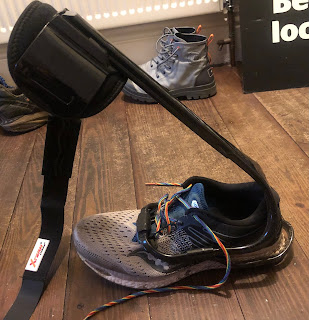
I suppose this is best illustrated in my running. I ran a bit before my diagnosis, but for whatever reason, started taking it a lot more seriously afterwards. I've run six marathons and countless other events since. My MS has weakened my left side and my left ankle is slowly losing its flexibility. This makes running harder, but thanks to the support of my MS team, I have been able to keep running using a series of different strategies, insoles and orthotic devices. The most recent of these is a pretty snazzy piece of kit that adds some spring-back into my ankle and seems to have stopped me from falling over.


Before this, I was falling over so often whilst running that I was beginning to cause myself some real damage. This brace works well enough that I've been able to go out running without wearing the wrist guards and kneepads.

 Even so, I'm basically fighting a losing battle. 

A consulant surgeon who specialises in sport (and who is a runner himself) told me about ten years ago that it probably wouldn't be my MS that ultimately stopped me from running; it was likely to be as a result of some of the compromises my body was being forced to make to compensate for weakness elsewhere. It seems that is likely to be the case for me. As well as the creeping stiffness in my ankle and the muscles of my leg, I'm told that the weakness in my left hip now means that my running gait has changed. Apparently, instead of driving my left leg through my running stride normally, I now "throw" it in front of myself because I lack the fine muscle control required. 

Running is hard and has got a lot harder over the last couple of years. My last marathon was in April 2019, and it now feels unrealistic to think that I could put my body through that kind of a distance, never mind the hundreds of miles of training. Perhaps more importantly, I'm not sure I have the kind of determination you need. Instead, I've found a joy in just being out and running at all. I can't run as far or as fast as I did before. Usually, at this time of the year, I'd be out with my club taking part in a local series of cross country runs. I've never been very quick, but they're very inclusive events and they are a lot of fun to run. There's a certain joy, I've discovered, in the mud and the hills. This year, I've sat them out. I just don't think it's realistic to put my body through that kind of stress and I'm just not confident that I'm strong enough to pick up my left leg over that kind of terrain for a 10km race.

All these things make me feel a bit sad, but I'm also determined to continue to focus on what I can do, rather than to dwell too much on the things I might have lost. 

I suppose this is what my neurologist means by acceptance.

He also told me that my MS progression was quite unusual: it is not at all normal for patients this far after their diagnosis to be as fit and healthy as I am (my first symptoms were in 2005 and my diagnosis was in 2009). This is obviously good, but it's also a bit depressing. Yes, I've been lucky, but I suddenly have a real sense that the sand is running out of my timer.

Over the last two years, my condition has progressed. I haven't really developed any new symptoms, but the symptoms I do have are getting worse and are affecting me much more in my daily life. I take drugs to help manage my bladder urges and I self-catheterise every night. I also take muscle relaxants to try and control the muscle spasms in my legs that have woken me up at night for a little while, but are now starting to affect the way that I walk and even make it hard for me to sit still in the evening. I walk stiffly and can feel that I swing my legs from the hip as I walk because I tire easily and don't have the strength to drive them through normally. I wouldn't be all that surprised if I needed to walk with a stick at some point in the relatively near future (I actually find walking a lot harder than running).

I am relentlessly positive about these changes, but that doesn't mean that they aren't on my mind. I am really disciplined about not allowing myself to wallow in where this journey might end. No one knows the answer to that one, whether they have MS or not. But.... it does make me a little bit sad.

I reckon I'm pretty strong and resilient, on the whole and maybe I am a shining example of disease acceptance...but these changes are still a lot to take in. 

Well, I'm doing my best.


Thursday, 18 February 2021

a vine that can strangle life from a tree...

I’ve never really been particularly sporty. I quite enjoyed playing team sports when I was at school, but there was never any sign of great talent. I wasn’t being picked last for our playground games of football, but I definitely wasn’t being picked first either. Running, however, I loathed. Every week, I think on a Tuesday or Wednesday, we would be sent out on a cross country run. Whatever the weather, we would run three or four miles across muddy fields and along the footpaths out around the school. I say run, but really, as long as I was fairly sure that there was no one looking, I would walk. I absolutely hated slogging my way through the mud and wanted no part of it. It would have been over more quickly if I’d run, but it all just seemed too difficult and too painful. Far better to trudge along miserably in the rain. If I thought I could have got away with hiding in a bush just out of sight, I probably would have done it. The idea that anyone might do this sort of thing for fun just seemed utterly ridiculous. 

Fast forward thirty years, and now it’s the idea that I might have to stop running that really scares me. I sort of fell into running when I stopped playing organised sport and started drinking beer. Popping out once a week for a rather laboured jog was a purely defensive measure designed to stave off an incipient beer belly. 

I didn’t actually start running more seriously until I was diagnosed with multiple sclerosis in 2009. My journey towards that diagnosis began one morning in July 2005, when I woke up with a numb hand. Over the course of the next few weeks, that numbness spread through my body and down through my legs and feet. Running when you can’t really feel your feet is an unnerving experience: you feel with every stride that you might miss your step and break a leg. I thought then that I might have to give up running, but it’s amazing how adaptable the brain is and how quickly you can get used to something that seemed insurmountable. 

As well as a loss of sensation, one of the most common symptoms of MS is fatigue. It sounds counterintuitive, but I discovered that going for a run was incredibly helpful at helping to shake off this fatigue. When you’ve been running, at least you know why you’re tired. Running made me feel better about myself. MS is a chronic illness with no cure and with uncertain outcomes, but running gave me a sense of control. Visiting an MS clinic at the hospital is a sobering experience; to be surrounded by people in wheelchairs, struggling to speak or to swallow is to be confronted by a possible future. I can’t predict or control how my MS might affect me, but I found that to be a powerful motivation to work my body whilst I can. I joined a running group and began to run with other people. I still wasn’t particularly quick, but it’s funny how running with other people makes you run faster than you thought might be possible. 

MS affects everyone differently. In my case, as well as the numbness and pins & needles, I have a loss of strength on my left-hand-side and a loss of dorsiflexion in my left ankle. This didn’t stop me from running, but as I quickly learned as I began to run more often, this changed my gait and made me more susceptible to injury as my body tried to compensate for the loss of strength and power. The further I run, the more I drop my left side and the more susceptible I am to falling over. A sports specialist consultant surgeon told me that I would probably struggle to run much more than 10km and that, although it might not be my MS that stopped me from running, the compromises my body was making probably would. Naturally, I ignored him and kept running. 

In 2015, I ran my first marathon. 

To be honest, the 26.2 miles itself wasn’t my biggest concern: I was worried how my body would hold up to the 500 miles of training and the load of running 5 or 6 times a week. I didn’t set the world on fire, but running side-by-side with my wife, we made it round and raised a pile of cash for the MS Trust (we’ve raised around £40,000 in total, an amount that mainly humbles me because of the support and generosity of our friends). 

Since that day, I’ve run another 5 marathons. At Chester in 2018, I even dipped below the magical 4 hour mark (a 22 minute PB!). I’ve joined an athletics club, picked up my coaching qualifications and taken enormous pride in the achievements of the athletes I coach as they have worked their way from a couch to 5km programme to running competitive cross-country races and half marathons. 

Meanwhile, slowly and remorselessly, my MS has got worse. My legs and left ankle have slowly stiffened; I take a muscle relaxant at night to help me to sleep and I now fall over so often that I run wearing knee pads and wrist guards; my pace has slowed and my shuffling, uneven gait is causing me problems elsewhere in my body (as that specialist predicted). Stopping, you might think, may be the obvious thing to do. 

I’m not going to stop. 

Running is part of who I am. My friends are runners. Running is something that I do together with my wife. It’s vital for my mental wellbeing every bit as much as my physical wellbeing. I’m not just going to stop. 

Sure, I wish I was faster. What runner doesn’t? 

I wish I didn’t fall over so much, but really, what choice do I have? 

Do I want to stop and feel sorry for myself and the things that I’ve lost, or do I want to keep on going as best as I’m able? Is that really even a question? Precisely because it’s become harder for me, I am more aware now than I have ever been of exactly how much running means to me and I cherish every single time I get out. It’s not the falling over that’s the most important thing to consider, it’s the getting back up again. 

I have a tattoo on my weaker left ankle by the Japanese novelist and marathon runner, Haruki Murakami: pain is inevitable, suffering is optional. 

The full quote, from “What I think about when I think about running” is: 

“Pain is inevitable. Suffering is optional. Say you’re running and you think, ‘Man, this hurts, I can’t take it anymore. The ‘hurt’ part is an unavoidable reality, but whether or not you can stand anymore is up to the runner himself.” 

This runner can stand the pain and isn’t done quite yet.

Friday, 18 September 2020

don't stop moving...


As they're obviously trying to keep (potentially vulnerable) people away from the clinic at QMC at the moment, I had my annual consultation with my neurologist over the phone today. Actually, it was a surprisingly effective way of doing it and was probably as helpful as any of the sessions I've had at clinic since I first started getting symptoms. 

The long and the short of it is that my disability has been slowly increasing over the last few months/years and today they've shifted my diagnosis from 'relapsing-remitting' MS to 'secondary progressive' MS. 

I think this sounds more significant than it is. Ultimately, it's just a label to describe the way my disease is progressing. Most people with MS have a series of relapses, each relapse bringing new symptoms and new problems which get a bit easier with time (without ever completely disappearing), before the next relapse arrives and starts the cycle again. Almost all the treaments for MS are designed try and slow down the frequency with which you have relapses, thus slowing the progress of the disease and increasing disability. There isn't a cure. 

I've never really had relapses and have just seen a slow, but steady increase in the severity of my existing symptoms. I haven't been on a disease modifying therapy for a couple of years now, so shifting my diagnosis is really only an acknowledgement of the way my MS seems to be progressing: I'm not expecting relapses, but I am expecting my legs to get stiffer (amongst other things). The shift closes the door to lots of treatment options, but may open the door to others. 

It's only a label... but at the same time, it can't help but feel like a significant moment. It sounds significant. 

Still, I have much to be thankful for: we're off on an 11 mile run tomorrow morning and I've run a little over 1,100 miles so far this year. Very little of that has been as fast as I would like, but I know that I'm still capable of running quickly when I really want to, and I was only a few seconds off my mile PB a few weeks ago. Whilst I now don't trust my legs to the extent that I won't go out without knee pads and wrist guards, running remains at least as important to me now as it ever has done and I cherish what I can still do. 

Every run, no matter how long or how fast, still feels like sticking two fingers up at this diease. Long may it continue.

Tuesday, 11 August 2020

be brave...

For as long as I can remember, I’ve been called cynical. Cynical, negative and pessimistic. For a time, I was called it so often that I almost believed it myself and began to build my sense of self around it. 

The cynic. 

To be honest, I’m not sure that this has ever really been the case. It certainly is true that, as a younger man, I would throw stones and would criticise without feeling the need to offer up anything constructive. I’m pretty sure I’m not alone in going through that phase. It’s also true that, when feeling frustrated or powerless at work (annoyingly often), I would sometimes deliberately seek to tear people down in a way that was ultimately self-destructive…. But I was young and stupid and I don’t work there anymore (which is probably just as well: some people choose never to forget the person you were fifteen years ago, even if you’ve long since changed). 

I think it probably boils down to this: I like to ask questions. These days, it’s usually to genuinely try to understand something because I’m curious. The problem is that lots of people don’t like to be asked questions; they don’t like to be challenged by someone because, if you don’t know the answers or you aren’t very secure in your opinion, it can feel as though you’re being criticised. No one likes to be criticised, right? I try not to be threatening about it, but nobody’s perfect and I’m probably not the finished article even now. 

I think my MS has changed me, actually. Or maybe it’s just revealed another side to my personality. Nobody knows what causes MS, nobody knows if it will progress for me or what my outcome will be. There’s very little that I can do to change any of these things. I’m not really one for serenity prayers, but I do think that this has taught me acceptance. To paraphrase Kipling, to meet with Triumph and Disaster and to treat those two imposters just the same. I’m calmer, more relaxed and better able to approach life on an even-keel (whilst also remaining perfectly capable of frothing in indignation watching the news. Nobody is perfect. My wife is doubtless scoffing as she reads this). 

What’s the point in being pessimistic? I’m well aware what MS might do to me and I know all too well what it’s already done. I simply don’t see how dwelling on either of those things does me any good at all. MS pages on Facebook seem full of people wrapped up in their own invisible pain and suffering. I don’t doubt that they suffer, but I simply don’t understand the attitude because I try never to allow myself to think like that. Perhaps that’s easy for me to say, but I hope it’s a philosophy that will stay with me, whatever happens. “The Road not Taken” by Robert Frost is one of my favourite poems; my interpretation of it is that you should never waste time regretting the path you didn’t take. 

They say that a pessimist is never disappointed. I think they’re always disappointed. Besides, I’m a runner, and as Kipling also said:

If you can fill the unforgiving minute 
With sixty seconds’ worth of distance run, 
Yours is the Earth and everything that’s in it, 
And—which is more—you’ll be a Man, my son! 

Well, I can definitely do that. Maybe not as fast as I use to be able to do it… but I can still do it.

Monday, 1 June 2020

if I surround myself with positive things...


It was World MS Day on Saturday.

I woke up at about 03:30 to find my whole lower body in spasm. from the muscles of my lower stomach down through my legs to my feet. I've been getting cramps in my legs for some time, but this is different, it's not a sudden clenching of the muscles but something that lasts for longer. It's not as intensely painful, but it is uncomfortable and has a halo effect that lingers in the muscles for some hours afterwards, as a deep-set stiffness in the muscles.

As I often do when this happens, I got up and walked very stiffly to the bathroom. This is partly to ease the muscles off, but also I'm now pretty entrenched in the habit of emptying my unreliable bladder when it is convenient. I catheterise myself every night before bed to ensure I sleep with a completely empty bladder and take a drug every day to help resist bladder urge, but as I was awake it was a way to kill two birds with one stone. It was already pretty light outside and the dawn chorus was really starting to get underway. It was really quite a lovely.

That done, I staggered back to the bedroom to try to get some more sleep, popping an ibuprofen along the way in the hopes of waking up with a bit less muscle pain.

This is my new routine.

We already know that the problems with my bladder are related to my MS: my brain isn't able to reliably empty my bladder completely, and I will often get the urge to pee even if I've only just been, whether my bladder is empty or not. It's likely that the muscle spasms in my lower body are MS-related too. There are drugs you can take to chemically relax these muscles and to try and get a good night's sleep, but I'm reluctant to take them. 

After all, I'm a runner.

Running keeps me sane. This was true before the lockdown, and it's doubly true now. My ability to get out of the house and clear my head on a run is precious to me. I'm probably getting slower as I get older, but the speed I run is not nearly as important to me as my ability to run at all. As things stand, I don't want to compromise the ability of my legs to carry me and so, if the spasms are the price I need to pay if I want to keep running... well, then it's a cost I'm prepared to pay.

Mind you, I have been doing quite a lot of running recently: I covered 145 miles in May, almost all of it side-by-side with my wife, who hasn't run as far in a month, even when she was training for her marathons. Quite a lot of this mileage has been slow, on stiff legs. Where the speed of my wife used to be our limiting factor, these days, it's more likely that she's waiting for me. It's not that I can't run fast any more - I'm doing at least one set of intervals a week where I try to let the brakes off - it's just that I'm really just happy to be moving at all; delighted just to get out of the house in this beautiful weather and to enjoy the fresh air and the flourishing spring around us.

On Saturday, after another couple of hours of sleep, I got up and went out for a 5km run. It wasn't fast and it wasn't pretty, but I like to think that it helped to stretch some of that stiffness out of my legs. Maybe, maybe not. Either way, it definitely made me feel better.

I was diagnosed with MS in 2009 after 4 years of symptoms. It's an incurable condition with uncertain outcomes, so it's a frightening thing to be labelled with. Maybe I'm one of the lucky ones, but I do firmly believe that MS only has as much control of your life as you allow it.

As this film from World MS day a few years ago shows beautifully, a diagnosis with multiple sclerosis does not have to mean the end. Life is what you make of it, and other cliches.


I think I'm much stronger and kinder now than I was in 2009, and I thank MS for that.

Wednesday, 12 February 2020

you are the unforecasted storm...

As an addendum to the post below, I received a letter the other day from the neurologist. Apparently, my November 2019 MRI scan shows no evidence of new disease activity.

This is clearly excellent news.

From the very beginning, my MS hasn't seemed to follow the usual patterns. Although I have technically been diagnosed with relapsing-remitting multiple sclerosis, where patterns of disease activity are followed by periods of remission and partial recovery, my MS has always behaved a bit differently. Most of my initial symptoms can be traced to a single lesion in my cervical spinal cord, but I haven't had a clear relapse since that first one and I don't seem to have developed any new lesions (the scarring on the brain or spinal cord left by the inflammation). That said, although I haven't developed any radically new symptoms, I have seen a general (albeit fluctuating) worsening of the ones that I do have. Relatively speaking, compared to others, I'm doing great... but the disease has changed my life. As well as the muscular symptoms of weakness, numbness and pins & needles, I also now take a pill to manage bladder urge and self-cathertise every night to ensure that my bladder is completely empty before I go to bed (I'm also careful of the volume of what I drink after about 20:30 at night. No more last orders at the bar for me). These things are different from what they were when I first developed symptoms in 2005. I may not have visible signs of disease activity in my MRI scan, but you can now see them in the way that I walk.

I think what this shows us is how complex a condition multiple sclerosis is; how it's an umbrella term for a massively varying set of symptoms and presentations. It's a handy label to put on people, but every single person seems to experience the disease differently. It's amazing how much the doctors and specialists do know, but equally very clear how much they don't know too.

I'm doing well. There's no sign of new disease activity in spite of the fact that I've now been off all medications relating to my MS for a couple of years now. It was a risk to stop injecting the drug that may (or may not) have been slowing my disease progression, but for the time being, it seems to be a risk that has paid off.

Long may it continue.

In the 43 days of 2020 so far, I've run 155 miles. I don't have much to complain about.

Monday, 10 February 2020

we are standing on the edge...

Sometimes I wonder how much I let MS define my life. I see memes on various Facebook MS groups that talk of no one understanding their world of invisible pain, and I just don't relate to them at all. I appreciate that different people process things in different ways, but I've always thought that I'm exactly the kind of person who doesn't wallow in the fact that I have multiple sclerosis.

But is that true? Can it be true?

Taking only this morning, I've worried about whether or not I'm finding it harder to sleep at the moment, I've thought about my bladder and bowel function, I've wondered if my bad back is being caused by any of the pills I take, I've staggered around on stiff, cramping legs and dragged a stiff ankle up and down the stairs a couple of times, I'm typing right now with numb hands. Is it really true to say that I'm not letting my MS define me? Just because I'm not posting memes about it?

Probably, some of these things will have nothing to do with my MS. A few definitely are, but I have to remind myself again that I'm actually extremely fortunate with my MS: my symptoms are reasonably stable and all of the above has to be taken in the context of the fact that I'm planning to go out for a 5 mile run this evening and that I've run 145 miles so far this year. Alright, so I'm finding running a bit harder at the moment, but it's not as though I'm doing much less of it.

I try not to put every little thing I feel down to my MS, but it is inevitably a filter through which I view the world.

Maybe that's the most insidious symptom of them all.

Thursday, 17 October 2019

I'll be needing stitches...

I had a busy day last Wednesday. I think it's fair to say that, since redundancy, my days haven't seemed quite as busy as when I was working 11 or 12 hour days every day.... but last Wednesday was definitely a busier day than average: a hospital appointment first thing, an appointment to take one of my MyGuide clients out for a walk at lunchtime, an interview with the charity that are looking to appoint me as a trustee and then the second week of the short course on creative writing that I'm taking at Nottingham Trent University.  By the time I got home at around 9pm, I was very much looking forward to sitting down with my tea and watching a bit of disposable telly.

At about half ten, I popped upstairs during an advert break (we were watching Elementary on Sky+. so we could have just skipped forward, but I needed to grab something from the bedside table). As I rounded the top end of the bed, I was unscrewing the lid on my drinks bottle when I was suddenly falling. I think my legs gave way, but as my hands were busy, I didn't have any time to react to this before my knees hit the ground and my chin hit the bedside table.

There was a short pause as I gathered myself and did a quick mental inventory: what just happened? have I really hurt myself? I was naturally a bit dazed, and my immediate reaction was to feel my teeth to see if I'd knocked any of them out in the fall. They seemed okay, but my ears were really hurting for some reason. At this point, I realised there was blood coming from somewhere, so I headed to the bathroom mirror to assess the damage. Through the beard on my chin, I could see a gaping cut. It wasn't more than an inch or so across, and it wasn't pumping blood, but it looked pretty deep.

Balls.

By now, my wife had rushed up the stairs to see what all the noise was about, and together we applied pressure to the cut and tried to work out what we needed to do next. It was tempting to do nothing and to just try and cover up the cut and go to bed, but I'd had a pretty nasty bang and the cut looked pretty deep, so we settled on calling 111, the NHS urgent care hotline. The operator on the other end of the line methodically ran me through the concussion protocols and then tried to assess the cut. I was coherent and seemed to be okay, but we agreed that the cut likely needed stitches and I probably needed to an x-ray. They passed my case on to the A&E department at QMC and told us to get there within the next hour.  It was a pretty efficient process and this call effectively acted as the triage for the hospital, and once we got there, all we had to do was to wait our turn. But there's the rub: we got there at about 23:30, and the screens were showing an 8.5 hour wait.

So we waited.

On my way back from my class, I'd wandered through town at about 20:30 and marvelled at the packs of students in fancy dress marauding through the city on their way down to Ocean. They were quite the spectacle, many wearing nothing more than a pair of speedos, and most of them being extraordinarily drunk for such a relatively early hour. As things worked out, I now saw several of the same people at the other end of the day, arriving at A&E covered in blood. Not a great way to end the evening, but most of them seemed in good spirits. Literally, I guess.

The staff were brilliant.There just weren't enough of them. One doctor and maybe three nurses for the whole department (there was another doctor, but he was called away). What made things worse was that several of the people waiting were clearly suffering from various mental health issues and were there because they simply didn't have anywhere else to go. It's heartbreaking to watch people sitting there with problems that an accident and emergency ward is never going to be able to fix. The staff are amazing, but they can't work miracles and they've been handicapped by a decade of austerity.

By the time we got actually seen by the doctor at about 6am, I was staggered by how cheerful he was, and how, even 11 hours into his shift, he was still looking for blankets to give to some of the shivering students. I was examined, X-rayed and stitched up. The A&E doctor thought he saw a fracture, so I was referred up to the Head and Neck ward, which was just opening up for further consultation. The consultant there explained to me that he was fairly sure that I didn't have a fracture, but because the A&E doctor had documented one, they needed to be super careful to rule it out. Did I mind waiting for a CT scan? Ah, what the hell. What's another couple of hours when you've already been there for ten?

So we waited. We had enough time to get a coffee and something to eat, but then it was the scan and a final consultation to hear the news that I almost definitely didn't have a fracture. They were worried about what's called a "Guard fracture", apparently: named after what happens when a sentry faints at his post and lands directly on his chin, causing fractures on the point of the chin and on the hinge of the mandible on either side (which is why the ears hurt).  I left the hospital with a sore jaw and a couple of stitches, but the feeling that I'd been really very lucky indeed not to have anything worse. A fracture might easily have involved extensive surgery and pinning.

It was a very, very long day.

The thing that I really don't want to think about is *why* my legs gave way. I think we probably know why, don't we? I've an underlying weakness in my legs, especially my left leg, that has been getting worse and worse recently. I've been moaning for a few months now how much harder running seems at the moment. I guess this is another thing that can happen. 

Understandably, I don't really want to dwell on this. I appreciate that something like this can cause as many mental problems as physical, but I really don't want to live my life like that. Maybe it's excessively stoical of me, but who wants to live their life like that?

Mad props to my wife for helping to pick me up and then spending a long, uncomfortable night at the hospital before heading off to work once we got home. I just went to bed, but she's hardcore.

Wednesday, 2 October 2019

slow down...

Let's not make any bones about it: I've been lucky with my MS.

Sure, I have some problems: numbness, pins & needles, muscle weakness and wastage, spasms, bladder issues, fatigue... but when it comes right down to it, I've run 6 marathons since I was diagnosed in 2009 and I still go out running 5 or 6 times a week. In the grand scheme of things, my problems are small.

Just recently though, things have been getting a bit worse and are really starting to affect my running. I was warned years ago that this day might be coming: a consultant specialising in sports medicine told me nearly ten years ago that it probably wouldn't be my MS that stopped me running directly, but it would probably be something caused by my MS. This doctor was a runner too, and he'd recently had to stop running because of back surgery, so he was quick to spot how important running was to me and quick to realise how critical it was to keep me on the road. He understood. To be fair, he also said that I would probably never run more than 10km again, so he clearly didn't know everything.

Perhaps he was just a few years early with his prediction.

I've been steadily losing flexibility in my left ankle for a while now but it's become quite stiff over the last couple of months and the achilles is very tender; I've had stiffness and numbness in my legs almost since the very beginning, but it's now taking me a mile or two to shake it off and get into my running stride; the muscle loss in my left side has been apparent for a while now, but I'm now getting niggles across my core and on my right side as my body tried to compensate.

I ran four marathons between April 2018 and April 2019. I'm still running around 25 miles per week and have run just short of 1000 miles in the calendar year to date. It feels ridiculous to complain because I've sat in enough MS clinics to know what this disease can do and how lucky I've been.

... but still, it is upsetting. I was hoping to run another marathon in spring 2020, but at the moment, even a half marathon feels like a bit of a stretch goal. We're almost exactly 12 months since I ran a half marathon PB (at Tissington) and a marathon PB (at Chester) in successive weeks.  It feels so frustrating to find my mileage restricted by a failing body.

Still, although it's frustrating, I hope I'm wise enough to realise that slowing down a little isn't the end of the world (even if it might feel like it is). That doctor was right: running 10km slowly is a lot better than not running at all.

Dangnabbit.

A runner just wants to run.

Tuesday, 20 February 2018

can't trace time....

When I was diagnosed with multiple sclerosis in 2009, I very quickly had to make two very important decisions: did I want to start taking a disease modifying drug (DMD)? If so, which one did I want to take?

Neither of these decisions is particularly easy. You’d imagine that everyone would want to be on a drug as soon as possible, but actually, NOT taking a drug is also a perfectly valid choice. MS is (currently) incurable and none of the drugs on offer can make any claim beyond *maybe* slowing down disease progression, although there will be no way of knowing if it’s doing you any good because everybody’s disease presents differently and advances at different rates. And, of course, they all have side-effects… which range from something as benign as getting a bit of a headache all the way through to developing a brain tumour. Nobody wants a brain tumour, do they? Lots of people actually find that the side-effects they do get are so awful that they would rather roll the dice and take nothing at all than face up to that.

For me, the decision was relatively simple: I would rather take something that might be doing nothing, than to take nothing…which is definitely doing nothing to help. The drug I chose was Avonex, and the reason I chose it was because it was a once-weekly injection into the muscle of my thigh that (at the time) I wouldn’t need to keep in a fridge. Yes, it involved a big needle, but I’m not squeamish and it meant a much lower level of general disruption to my life than some of the other drugs that needed injecting several times a week.

As it turned out, I seemed to tolerate the injections fairly well: a couple of paracetamol and 400mg if Ibuprofen before injecting at bedtime, and I seemed to be able to ride out the worst of any side-effects. Occasionally I’d wake up the morning after feeling completely drained, but I certainly never got any of the flu-like symptoms that many other users reported. I tolerated it well, my blood tests seemed relatively normal (on these sorts of meds, you need your blood monitoring to make sure they’re not doing you any form of mischief elsewhere) and, most importantly of all, my MS didn’t seem to be progressing. Never mind that newer therapies – many of which didn’t involve injections at all – were coming onto the market; why change?

For the last three or four winters, I seem to have become susceptible to chest infections that linger for several months. As a runner, this has been annoying, but it was only when my GP mentioned to me this year that this was something that was likely to happen to me every year now, that I even really began to think that it might be down to something other than bad luck. The drugs used to manage MS essentially work by damping down your immune system in an attempt to stop it going rogue and attacking my own nervous system. Is it really such a leap to imagine that suppressing my immune system might lead to other infections? Well, perhaps that was still a trade-off worth making… but then I started to get swelling and white mottling on my tongue and on the back of my throat. I didn’t have any signs of a bacterial infection and came back negative for fungal infection… was I starting to get an allergic reaction to my medication? One week, my throat swelled up within minutes of my injection, and my MS Nurses just told me to stop [I wrote about that the other week]

Did I mention that the MS Nurses are great? They've offered me front line support since the day I was diagnosed and one of the reasons that we support the MS Trust is because they provide the funding and training that helps the MS Nurses carry out their vital work.  We're running a marathon in April to raise money to support that work, and you can sponsor us here..... the MS Nurses all remember me when I ring because I'm the runner.  This money is needed precisely because it's so unusual to run a marathon with MS.  Most cannot.

Heck, on Saturday I ran 18 miles before breakfast! I was out of the house at 05:45 wearing a head torch!  I know!  And a 5.2 mile club cross-country race through knee-deep muddy water on Sunday!


Anyway.

A month later, my throat is clearing up… but what next? Obviously, it’s not much good taking nothing at all. I’m feeling better, but presumably the same decision I made in 2009 still applies: I’d rather be doing something than doing nothing. But what am I going to take? Well, I spoke to Kate the MS Nurse again today: apparently, although Avonex is one of the older treatments, it is also one that suppresses your immune system the least; all of the others hit you harder. But does that mean that taking them would make me even more prone to infection? Was the infection down to the Avonex suppressing my immune system, or was it something else? I’m told that it’s unlikely that my neurologist would want me to continue with it (only now do I learn that 9 years is a long time to be on Avonex), but it’s not clear where I go from here.

Meanwhile, I wait… and hope that I don’t have a relapse in the meantime.  It's something like this that helps me to remember how lucky I've been in the 9 years since I was diagnosed. I really haven't had any great dramas from my MS and - relatively speaking - I still don't really have a great deal to complain about.

At least I’m not very likely to catch a cold.

Swings and roundabouts.

* UPDATE -- the neurologist wants to see me. My next appointment is in November, so they're seeing if they can get me in over the next couple of weeks. His preference is to keep me on the Avonex as I've responded so well to it over the years, but.... who knows?

Wednesday, 30 August 2017

latch on to the affirmative....

As you might imagine, I've connected with the MS Trust on Facebook.  It seemed a natural thing to do, given that they're an excellent charity and we fundraise for them.  I was thinking that maybe I'd get some updates on the charity's latest work and other news about the various research and breakthroughs that are happening in the world of MS.  I get all of that, but what I wasn't really ready for was the community.

Facebook is many things - not least of which is that it is an appalling time sucker - but one of the things that it is best at is bringing communities of people together.  Whether it's a loose grouping of friends who are scattered around the country and around the world, or whether it's your local parkrun or whatever.... it provides a simple, accessible way to be in contact with lots of like-minded people. To give an example, I really enjoy being a member of the Virtual Runner UK group.  Although formed mainly as a platform for people to discuss the Virtual Runs they've entered - something that I don't really do all that often and only started because it's a local company and have supported the charities of several of my friends, including my own - but it's grown into something much more than that.  In the main, the people drawn to virtual runs are the kind of people who are just getting into running and want to earn medals but are intimidated by the idea of entering an actual race. What the community has grown into is a hugely supportive group of people who are encouraging other people as they take their first steps into a healthier lifestyle.  I think it's brilliant.

In theory, the MS Trust community is something similar: a group of people who have a shared experience and are able to offer each other support and perhaps to share the benefit of their own experiences.  I know from experience that being diagnosed with MS can be a long and frightening process, and it can be very reassuring to talk to other people who have been through the same thing and can tell you that life still goes on.


....except that the problem with this particular community is that, if you believe what you read posted here, it seems like life doesn't go on and that, if it does, it really isn't worth living.  Here's a recent post: "I don't think I want a driverless car. Most of my body seems to be driverless and unresponsive now so the only time I can shift is with my right foot on the Go pedal in the car. I don't want to be deprived of that ability to control moving about as well".  Is it me, or has she really had to reach for the negative there?


I've talked on here before about how there's an unfortunate tendency for blogs on MS to turn into pity parties.  Whilst I understand that what people choose to write about isn't necessarily their whole experience and that it can be therapeutic to just let it all out as a form of primal scream therapy... frankly, I don't have much patience for it.  What good does it do you to wallow?  In the final analysis, what's important is what you have, not what you've lost, isn't it? None of us have any control over this illness and mourning a life you can no longer lead just seems to me like a massive waste of the time you have left.  I don't mind people talking about their own experiences, but it drives me crazy when it all degenerates into a kind of "oh, poor me" or a "nobody knows the troubles I've seen" competition. Let's be clear: in that competition there are only losers.


I realise that I'm wide open to people dismissing my opinion on this as irrelevant: it's easy for me to have that attitude when I'm still able to run marathons, isn't it?  ("There's always someone like you who can run marathons or climb mountains.  I can't even get out of my front door", as someone once sneered at me).  There's clearly an element of truth in that, but you have a choice, don't you?  You can choose to be positive and to try and live your life with what you've got, or you can choose to be negative and to wallow in the injustice of what you've lost.  When I read the "29 things that only people with MS will understand", I genuinely don't understand why everyone else is commenting things like "So true, so true", when all I can wonder is why these people are defining themselves with these labels.  I like to think that, if things were ever to get worse for me, that I'd cut my cloth according to my circumstances and try to make the best of it.

Hopefully, I'll never have to find out.


...but the MS Trust group is awash with negativity.  Even when people are asking relatively benign questions and posting links ("What do you think of this?" and so on), the comments are often miserable and small-minded.  Someone actually posted the other day asking for people to try and be positive and to share something nice that had happened in their lives, and all he got in return was people telling him they couldn't because nothing nice had happened in their lives.  Really?  Oh come on.  It then degenerated into people slagging off the people who did post nice things.


If you ever see me commenting "So true" underneath a meme like any of these, please find me and slap me.  Even if any of these things are part of your experience, they're not true all of the time, are they?  This last one?  I fall over when I run, but I pick myself back up and I keep on running.

Isn't that how any of us should try and live our lives?

As the song says:

You've got to spread joy up to the maximum
Bring gloom, down to the minimum
Otherwise pandemonium
Liable to walk upon the scene

can I get an amen?

Monday, 3 April 2017

we can to move on up...

I'm worried about my legs.

It's not usually my policy to moan about my health here, but I'm concerned that the recent problems I've been having with my legs might be something that I'm just going to have to learn to live with. This is my ability to run we're talking about here, people.  CODE RED!

I've whinged about this already (here, here and here), so I'll try not to go on about it too much.  The thing is.... I feel like I've been lucky with my MS so far.  Sure, I've got some challenges... but in spite of all that, I've been able to keep up with my running.  More than that: since I was diagnosed in 2009, I've joined a running club and actually massively increased my mileage.  Not only have I made lots of friends doing this, but although it might sound ridiculous, I don't think I would even have thought of running a marathon before my diagnosis, never mind running two and raising £22,000 for the MS Trust.  

MS has taken some things from me, but I honestly think that it has made me a better, kinder person; it's also revealed my stubborn, determined side.  I'm less angry at the world now than I used to be, but I'm also merciless with myself and refuse to make any excuses for not getting out for a run, no matter how I'm feeling and no matter what the weather might be doing.

Much of my sense of self is bound up in my running.  I might have an incurable neurological condition, but as long as I've been able to run, I've been able to feel like I have some control.  No one needs to tell me what MS could do to me... trust me: I know.  I'll cross that bridge when I come to it.  There's no point worrying about things you can't control.

...or so I thought.

Now, suddenly my legs feel stiff and weird and I'm worried about falling over when I run.  How quickly things change.  Look on my works ye mighty and despair!  I've scuffed the foot on my weaker left side for a few years now, and falling over when running isn't a new thing... but I don't even remember tripping when I went down the other day; I was just upright one moment and then on the floor the next.  I don't like the fact that I can't explain what happened as a simple trip.  It's knocked my confidence and the fact that I just don't feel steady on my legs every time I run really isn't helping. As I was sitting wearing shorts as my scabs dried the other night, I noticed that my thighs are now visibly different in size.  I measured them: my left quad is now 5cm smaller around than my right.  It's noticeably weaker too.  This isn't a surprise to me, but it is visible proof of the damage that MS is doing to my body.

Am I going to stop running?  No, of course I'm not.

Am I worried about what's happening to me?  Yes.  I am.  I'm worried that I'm just going to get slower and slower and that one of the things that is most important to me will slowly be taken away from me.  I'd also be lying if I didn't tell you that I'm finding it a little frustrating that many of my friends are getting faster - through their own hard work and talent, I have to say - and I just seem to be running through treacle and getting slower.

But.... but... but.... why the self-pity?  Am I not still running?  What right do I have to be moaning?

I ran a little over 4 miles tonight at a shade over 8.33 minutes per mile.  My legs felt wobbly and pretty rubbish throughout, but that's a perfectly acceptable pace and was much faster than I'd assumed I was moving.  This comes on top of six miles on Sunday and 3 miles on Saturday.  That's more than thirteen miles in the last three days.  And a couple of weeks ago I completed a half marathon.

Maybe I should be focusing on what I can do rather than what I can't.

I didn't used to be this stoical either, you know.  That's another thing I probably owe to MS.

Monday, 20 March 2017

I keep on fallin'...

MS is a sneaky condition.

Yesterday, I was running a half marathon and generally feeling on top of the world; today I set out to run a quick 5km with my running club to loosen up my surprisingly-stiff muscles and I took a bit of a tumble.

It was the Reading half marathon yesterday and I ran round in support of my friend Karen.  We've been blog buddies for a while now, so it was a pleasure to run round the course with her.  I ran this as a warm-up race for London marathon in 2015, and C. and I managed 2:06.... it was my slowest half marathon ever, but it was also the one that I have enjoyed the most.  Yesterday, we managed around 2:45 and I think I enjoyed it even more (I had a beer at the drinks station outside the pub at about 8.5 miles, for starters...).  Clearly, I am capable of running much faster than that, but I was happy to do everything I could to support my friend around the course as she raised good money for the MS Trust.  Karen found it tough going after around eight miles, but she showed some real guts in getting the job done without a word of complaint and I'm full of admiration.


It was a good day; much more tiring than I was expecting, but it was a really good day.

And then I fell over.

I'd been tired and stiff most of the day, but I was determined to get out for a run tonight, even if it was only for a slow 5km.  Normally, when I fall (and it happens to me more than I'd like), it's because I drop the foot on my weaker left side and start to scuff and trip. This time, I had no warning at all and just went straight down on my left side like I'd been shot. Tired muscles from yesterday, I suppose.


There's no real harm done beyond a scuff on my knee, some bruises on my wrists and knuckles (I like to think my cat-like reflexes ensure I do a mean ninja roll as I hit the ground, which would perhaps explain the red, angry looking marks on my left shoulder)... but I really hate being reminded that I'm not bulletproof and that this condition is slowly taking a toll on my body and on my running.

I'm not stopping running, obviously... I ran a half marathon yesterday, did I mention? I probably just need to be a bit more careful and take things a bit easier (stop laughing at the back!)  I've also got a pair of insoles and an ankle cuff that are designed to try and stop me dropping my left side as I run, but I left them both at home today.  I suppose using them when I run would be a reasonably good starting point, eh?

As I stood in the shower and noticed the marks on my left shoulder, it dawned on me how hard I must have hit the ground and actually how lucky I was to have got away so lightly.  Ask me how I feel tomorrow morning, but given that one of my running friends fell over last year during a race and broke his elbow and another fell over the other week and lost one of her front teeth as she face-planted onto the road, I've been pretty lucky.


Thanks goodness for sapphire crystal Garmin screens too, eh?

I'm also very grateful to all the wonderful members of Rebel Runners who showed me so much concern this evening and offered me (and my bike) lifts home and things. It's a lovely running community and it was joining them in 2011/12 that completely changed my running life, so I already owe them loads.  Thanks guys.  It's very much appreciated.

Honestly.  Good job it's nearly summer...those leggings are ruined!

Wednesday, 22 February 2017

don't stop 'til you get enough...


The mind is a powerful thing.  In the summer of 2005, a numb right hand was the first symptom of what was ultimately diagnosed as multiple sclerosis.  That was worrying enough, but that sensation of numbness quickly began to spread across my body, creeping down through my legs all the way to the soles of my feet (it turned out to all be caused by a lesion on the spinal cord in my neck, hence the widespread impact throughout my body).

I didn't run then anywhere near as much as I run now, but I still did the odd half marathon and liked to go out a few times a week.  Think for a moment what it's like trying to run on legs where the muscles suddenly feel numb and when you can't feel the ground beneath the soles of your feet.  It was so weird that I actually thought for a while that I might have to stop running altogether.  What would happen if I mis-stepped and fell over? The loss of sensations in your muscles that you would normally take entirely for granted made me suddenly feel very unsure of myself.

I was afraid.

But I kept running.  It ultimately took me four years to reach a diagnosis of MS, but through that time I just kept running, slowly at first but then faster and faster. It's amazing how quickly your brain begins to adjust to a new normal, and before long, I was running further and faster than ever before.  In fact, I think the diagnosis actually made me more determined than ever not to give up: I seriously doubt that the pre-diagnosis me would ever have even considered joining a running club and taking part in a marathon.

I know this.  I also know that I'm a fairly determined, stubborn old bastard, and I like to think that, should my symptoms worsen and I am unable to continue with my running, I will find something else to keep myself active.

But I still find myself worrying about the way my legs currently feel like they belong to someone else, possibly to someone who has been dead for several months? There's a new stiffness in my legs now that sees me staggering around like an old man first thing in the morning and after I've been sat down for a while.  I can feel it when I'm running, and I can feel myself becoming more cautious and slowing myself down.  Are these new symptoms? Is this temporary, or will I feel like this forever now? Perhaps this is the beginning of the end? Perhaps I should start to be more careful?

My rational brain tells me that I should keep going: my brain will adjust to a new normal soon enough, just as it did before.  It might take a while, and perhaps I'll have to slow down for a bit and maybe I won't ever manage to be as fast as I'd like to be.... but I can surely keep running.  I know all this.... but I'm still afraid; I'm afraid of the symptoms I feel and of what they might mean.

But you know what? Whilst all this has been going on in my head, I also went and joined that Athletics Club where I've been doing track interval training on Thursday nights.  They're a really friendly bunch and have made me feel very welcome over the last few weeks... I doubt myself every week, and I spend most Thursdays in a state of mild dread about the evening training session ahead because I can't quite shake off the feeling that I don't belong and that I'm nowhere near a good enough runner to be even thinking about training on the same track as these thoroughbreds.  I know rationally that no one cares about how fast I run and that they're simply delighted to have me on board and want me to be as good a runner as I can be... and I enjoy the sessions (once we're finished, anyway - it hurts!) All the same, the demons in my head keep whispering these negative thoughts, doubling down with the way my legs feel and trying to convince me to take the easy way out and to give up.

I felt that fear and I decided to join anyway. I feel the fear before every track session, but I go anyway.  Not only am I going to keep running, but I'm going to keep trying to push myself to be as good a runner as my body and - perhaps more importantly - my mind will let me be.

[partially inspired by this article on running demons]

Monday, 6 February 2017

ignoreland...

Stiff, heavy muscles are nothing new for any runner, but I'm now starting to be increasingly bothered by spasms and spasticity in my legs. Most mornings I stagger around on stiff legs until the muscles seem to wake up properly and let me move more freely.

As you can imagine, this is somewhat tiresome.

After a relatively good run over the last few years that saw me complete two full marathons with barely an issues at all, I've had a few niggly little problems recently that have affected my running: muscle problems in my leg on the weaker left side of my body held me back a little over the second half of last year; there was the never-ending chest infection that lasted six weeks around Christmas; and now there's a cracked rib and a broken toe...  My wife sometimes remarks that I've had a good innings and it might be time to put me out of my misery by taking me on one final journey to the vet.

I won't lie to you: it's annoying.  Lots of my friends have been getting fitter and fitter and are really pushing their limits and seem to be lowering their PBs every week.  I've never really been all that interested in PBs (or in competitive running), but I'm very happy for them and have been inspired by their progress.  What I find frustrating isn't that I'm not running super-fast and smashing all my PBs, but rather that I'm not running as fast as I would like.  To some extent, that's true of every runner who ever laced up their trainers... but equally, I'm keeping a weather eye out for any sign of permanent physical deterioration, and I don't like what I'm seeing.

Yes... it's true that by almost any benchmark, I'm doing pretty well.  I'm 42 years old and I suffer from multiple sclerosis.... and yet I ran the London marathon in 2015 and 2016; I ran 45km in 24 hours at Thunder Run in July last year and will do at least the same again this year; I covered well over 1000 miles last year and I would expect to do something not too far off that again this year.  Whilst I might not be running as quickly as I would like, I'm not actually running too slowly at all.  Marathon training seemed to take some of the speed out of my legs over the last couple of years, so now that I'm not doing the really big training runs, I'm probably trending faster year-on-year.

But I want to do better.  My body might be starting to give me some warning signs, but this is making me more determined than ever to flog as much out of my body as I can while I still can.  That's why I'm going to join a running club and why I'm going to continue to drive myself as best I can at their track sessions on a Thursday night.  I don't want to slip gracefully into a gradual decline... I want to fight it all the way, kicking and screaming.

I have a friend with MS who relies heavily on sticks to walk and, of course, there are plenty of other people with MS who find themselves confined to a wheelchair.  Their physical condition has got nothing to do with their personal determination, but everything to do with their particular disease progression.  My disease progression may well be different.  Who can say?  I would be lying if I didn't say that I am a bit worried about what my future might hold and what this new stiffness in my legs might mean... but I'm damned if I'm going to let that stop me from running before I have no other choice.  I did a 4.5 mile run in the pouring rain this evening.  My legs felt terrible for the first couple of miles and then suddenly seemed to loosen up as I went along.  I can't exactly tell you that I enjoyed the run, but I'm certainly glad that I did it [sidebar: read this... "I hate running"]

Another friend asked me today how I could even think about running with a cracked rib and a broken toe (never mind the rest of it).  I told her that it doesn't seem to make them any worse, and it's only pain*.

Her: "I think I need you in my antenatal class tonight [she's a doula] when we talk about labour."
Me: "Well, I wouldn't have the brass neck or stupidity to lecture those ladies on pain management!"
Her: "No but you can tell a good story about the difference between pain and suffering."

Funnily enough, I have a tattoo about that.


That's on my weaker left side (you can see some of the scars my ankle cuff has left me with).  Coincidentally that's the same side as the broken toe, although I'm not so much blaming the MS for that as a stray suitcase left between the end of the bed and the wardrobe that I encountered at 3am the other morning....

* I also take painkillers. I'm not an idiot and will-power can only get you so far.

Wednesday, 30 November 2016

breathe without you...

Ironically, given I have a chronic, incurable medical condition, I’m not very good at being ill. Hmm. Actually, perhaps that’s entirely unsurprising. After all, I doubt that there are many people who become fonder of hospitals the more time they spend in them.

I have a cold. I don’t think that I’m one of those guys who makes a whole song and dance about their terrible “man flu”, but I definitely don’t like being ill and I try my best to let it interfere with my life as little as possible. I think the only sick days I have ever had were 1 day when I had campylobacter and was delirious with a fever and stomach cramps, and I had to have a few days off after my lumbar puncture when the altered pressure in my central nervous system meant I couldn’t stand up for more than about half an hour without getting pounding headaches and breaking into a cold sweat. So yes, this does mean that I’m one of those people who turns up to work and coughs and splutters my way through a day. Yes, as someone with a compromised immune system myself, I could perhaps be a little more considerate… but the plain truth of the matter is that, unless I feel really unwell, I’m going to come to work. I don’t do duvet days.

With this particular cold – which developed nicely into a case of viral bronchitis – I sounded terrible, but always felt basically okay. 85% of normal, maybe – so I just tried to carry on with my life as normal. Sadly for me, this meant that I could work, but once it descended into my lungs and took up residence, exercise is out of the question. I did my last run 12 full days ago and even had to stop cycling to and from work when I started wheezing on the way home a week ago. I don’t particularly feel like exercising at the moment, but as someone who has run over 1000 miles this year and goes out 5 times a week, this is proving to be very difficult. I’ve started cursing the runners I see out on the streets under my breath. The bastards… what a bloody cheek that they’re out enjoying something I want to be doing but currently can’t. I keep setting myself little targets: I’ll start cycling to work again on Wednesday and will maybe do a little jog when I get home… but so far, my lungs just haven’t cleared up enough to make that possible (at one point this week, my wife woke me up at about 3am to rub Vicks onto my chest. It’s a lovely gesture, to be sure, but I think my coughing in my sleep was starting to fray her nerves). I think I’m going a bit crazy. I’m aiming for parkrun this week (and will be there, come hell or high water, even if I have to walk), but I’ll reluctantly have to play it by ear. Annoyingly, I’ve got a half marathon booked on Sunday next week… at this rate, even if my lungs clear up, I’m not sure it would be a very good idea. Dangnabbit. I hate being sensible.

Mind you. That being said, it’s also sort of nice to have all this time on my hands. It’s amazing how much earlier I’m getting home and how I can actually just sit down and watch telly or something like a normal person. It’s weird.

Naturally, I’ve put this time to excellent use by starting to play Skyrim again. I’m trying to make my character run everywhere.

If I can’t flog myself, I don’t really know what else to do.

Oh, and you know that thing where you cough so hard you rupture something in your ribcage and it makes coughing even more miserable?  Yeah.  That.  Good times.

Thursday, 27 October 2016

benign...

I had an MRI scan of my brain and cervical spinal cord at the beginning of September. I wrote about it before, but to cut a long story short, this was my first scan since 2005 and my neurologist wanted to see if there had been any progression in my multiple sclerosis. I had my first symptoms in 2005 and was formally diagnosed after a lumbar puncture in 2009, but my disease progression seems to be unusually slow – which is great news – and there was some talk that I might even be able to come off my weekly injections.

Needless to say, I’ve been anticipating the results ever since. How can it not be interesting to get a snapshot of what’s happening inside your own brain?

The NHS being the NHS, nearly two months later and I haven’t had anything back yet. I rang the MS nurses to see if they could chivvy something along… but the very fact that they have a message on their answering machine wearily telling you who to contact if you are waiting for MRI results tells you that this sort of a wait isn’t at all unusual. I chased my neurologist’s secretary, as instructed, but I took the opportunity of a visit to my GP this morning to ask if he had received any results yet. He hadn’t got a letter from the neurologist, but thanks to the wonder of the NHS "spine", he was able to connect to the consultant’s report on my NHS record directly and see what it said.

The report is mostly impenetrable, of course… but the long and the short of it was that I clearly have a number of distinct lesions in various parts of my brain and in my spinal cord. The reason they haven’t written to me, I think, is that they say in the report that they're looking for the comparison scan so they can measure disease progression, but they obviously haven’t been able to find my 2005 scans from a different hospital (they can have my copies, if they want). What I remember from those original scans is that they could only find evidence of one lesion (or sclerosis) – in my neck – which was causing my initial symptoms. The reason it took so long for me to receive a formal diagnosis was that, in order to definitively say that I had MS, the neurologists obviously needed to find more than one sclerosis.... they don't just hand out life changing diagnoses like this willy-nilly, you know...and the scan just wasn't clear enough.

Well, it sounds like this isn’t an issue any more.

I was hoping that my relative lack of disease progression would be accompanied by a clear MRI scan.
Apparently not.

So, how does this make me feel? Well, rationally, it doesn’t change anything: I remain fit enough and capable enough to run fairly long distances, and the discovery of new lesions doesn’t in itself change that one little bit. I say here a lot that I know how lucky I am; how relatively unaffected by MS I am. I know that sounds excessively stoical, but it’s true. However, I also know that my symptoms affect me more heavily now than they did in 2005. My MS doesn’t seem to be following a classic relapsing/remitting profile, but that doesn’t mean that it isn’t progressing at all.

Putting aside all rationality - something that I find difficult at the best of times - how does this affect me emotionally? Well, truth be told, there’s a little part of me that has held onto the fact that I’m an unusual case and that my MS is relatively benign (my neurologist even occasionally calls it Benign, with a capital “b”). I liked to imagine that perhaps things would never get any worse, even when I could see that my symptoms were actually slowly getting worse, at least there was nothing new. The fact that I never really experienced any new symptoms beyond those I experienced in the summer of 2005, only variations around a theme, allowed me to imagine everything was tickety-boo. Benign.

Sadly, I now have a much clearer idea of what's happening inside my skull.

Although the discovery of new lesions doesn’t materially change the way I feel, it does rather take the comforting thought of 'no progression' away from me.

Monday, 17 October 2016

cos I hobble when I wobble...

I'm acutely aware that this blog is a little in danger of turning into an MS blog.  No matter how much I want to be writing about inconsequential ephemera, I seem to keep coming back to my multiple sclerosis. I try not to allow it to dominate my life, but there it is.  That and running.... or actually about how it affects my running. I try to have lots of other facets to my life that I extemporise on at length here, but i'm afraid that my portfolio of subjects seems to be narrowing.

Of course, when it comes to MS,  I’m very aware that - relatively speaking - I’m pretty lightly affected. If I was looking for a dedicated following of the kind of people who really hoover up the misery of MS Sufferers - and I have to tell you, that if you are a part of this audience, then there are many, many blogs for you to choose from that will be all too eager to serve you up some unmitigated wallowing - then you're probably looking in the wrong place here and you'd best go back to Azkaban with the other dementors.  In fact, eleven years since my first symptoms and I’m probably as fit as I’ve ever been. I’ve run a couple of marathons, for goodness sake… things could definitely be worse and I try not to moan about my lot in life.  Why moan about my health when the country - THE WHOLE DAMN WORLD - is going to hell in a hand basket around us?

But of course, that doesn’t mean that MS doesn’t affect me at all.

Any misery hoovers still there?  I know I generally seem excessively stoical about such things, but let me throw you a bone:

I’ve been bothered over the last few weeks by my legs: they don’t quite feel like they belong to me; they’re stiff and awkward and I’m finding increasingly myself hobbling around like an old man. It’s affecting my running too, and although my mind and heart and lungs are willing, my legs just aren’t able to carry me as fast as the rest of me wants to go. Although, to be fair, every runner probably knows that feeling.

It’s frustrating. I'd love to be setting new PBs like all my running friends seem to be doing at the moment... but I'm miles away from that kind of form. I'm delighted for them, of course I am... but I'd also love to be improving and not going backwards and running through treacle.

The other night, I had restless legs, with the muscles of my thighs twitching uncontrollably of their own accord as I watched TV on the sofa and tried to ignore them. The next morning, it took two attempts to get out of bed and to get my legs working at all. I'm still running, of course - I ran that very night.  It takes more than something as trivial as my legs not working properly to stop me running...If I thought that, then I would have stopped running years ago.  To be honest, I'm also not sure that resting will help all that much; this might just be how things are for me now.  I'm stoical about this, but it's still frustrating to feel so slow and to feel that 26.2 miles - a distance I ran as recently as six months ago - currently feels like a very, very long way.

But of course... 26.2 miles *is* a long way.  A really long way. I really shouldn't feel bad about slogging around 6 miles: it might be slower than I'd like, but at least I *can* still slog around six miles.

It probably sounds ridiculous, but no matter how slow and painful it might be, I do try to remember that running still feels a whole lot better than not running.

In fact, given that I'm not running a marathon in 2017.... is it bad that I'm thinking of entering a 20 mile race?

Wednesday, 18 May 2016

bad head...

I’m usually fairly blasé about my injections. I suppose that might sound a bit odd when you consider that it involves putting a 2 inch needle deep into the muscles of my thigh every week, but it’s just something that I do.

I’ve been injecting since the summer of 2009, and I’ve injected in all sorts of places: outside a tent in Etosha National Park in Namibia, in a campervan on the Great Ocean Road, in Cambodia, Vietnam, Canada, New Zealand, California, Milton Keynes… all sorts of places. One thing that I have learnt in that time is that it's surprising and maybe a little alarming how easy it is to take these needles through customs. They can’t be stored in the hold of an aircraft because of the danger of the liquid freezing, so I have to carry them in my hand luggage. I used to ring ahead to warn airlines, but I don’t bother anymore because they're just not interested, and the only customs officials who ever asked to look at them were the ones in Hong Kong, where the doctor’s letter I always carry seemed to reassure them that I was legit. Given that they won’t give you metal cutlery on a plane (unless you turn left when you get on board, so my wife tells me), it’s maybe surprising that they don’t care more about a big needle, but there you go.

It’s just a part of my routine and I don't want it to be any kind of a drama. Some people stop injecting because they can’t deal with the side-effects, which can apparently be pretty horrendous, but I’ve always been fine. I take a couple of paracetamol and some ibuprofen before I inject and then think nothing more of it. As long as my quarterly blood tests show that it’s not affecting my liver function, we’re all good. It’s not as easy for some people, and as well as injection site problems, people report terrible headaches, shakes, sweats and general flu-like symptoms. The worst I usually get is the occasional gushing vein and a general feeling of weakness the morning after… not very nice, but nothing I haven't been able to handle.

I injected last night as usual, but when I woke up this morning, I felt terrible…… thumping headache, aching muscles and eyes that felt as though they were filled with glass. Even my eyes hurt, for goodness sake! As I struggled my way out of bed to get ready for the cycle to work, I realised that I’d completely forgotten to take any analgesic before turning in after my injection. So, for the first time ever, I was feeling the full force of the side-effects.

…well, I’m never doing that again.

Ugh.

One of my neurologists suggested to me a little while ago that I should maybe think about removing that dose of paracetamol and ibuprofen from my weekly routine as I probably didn’t need it anymore. I ignored him, mostly because the same guy also told me not to be afraid of using the same drugs to help me manage my symptoms. Judging by the way I felt this morning, it looks like it’s a good job that I didn't listen.

I just can’t imagine waking up feeling like this every single week the morning after injecting myself. This, after all, is a drug that I take because it’s hopefully slowing down disease progression. There’s no real way of proving if this is actually working, so I imagine I’d get bored of injecting it pretty quickly if this is how it made me feel.  Who would do that to themselves? I might be stoical and phlegmatic, but I'm hardly an idiot.

And it started raining just as I pushed my bike out of the door to head to work.

Of course it did.

Wednesday mornings - so often the morning after the injection the night before - have not really been my favourite time of the week over the last few years.