Showing posts with label WTs. Show all posts

Wednesday, 19 March 2025

travelling without moving...

 I feel like life with Multiple Sclerosis - at least for me - is to permanently exist in a liminal space. 

I experienced my 1st symptoms 20 years ago this summer, but was running marathons until lockdown. 

I still run, swim and row, but I also occasionally walk with a stick. 

I can ski black runs, but I'm often too weak to stand up unassisted if I fall.

I’m not on any disease modifying drugs, but I take shit loads of meds to help control my symptoms. 

I self-catheterise, but present (mostly) as a normal, healthy guy.

I’m in transit, but never arrive.

Friday, 13 May 2022

blood on the tracks...

TRIGGER WARNING: if you’re squeamish, you might want to sit this one out.

--

I’ve been intermittently self-catheterising for a few years now. For those not in the know, this is where you take a lubricated, 40cm long plastic tube and insert it into your urethra until it reaches your bladder, at which point your bladder drains. Why do I do this? Well, one of my least favourite things about multiple sclerosis is that the nerve damage it causes has affected the wiring between my brain and my bladder. What this means for me is that my brain tells me that I need to pee much more often than I actually do need to pee, but also means that my bladder doesn’t completely empty when I do pee. This is a pretty toxic combination, because retained urine can cause infection and also because it means that you can’t trust the signals from your brain telling you that you need to pee. Annoyingly, on top of this, I also get sudden bladder urgency, where I will go from not needing to pee at all, to desperately needing to go in the space of about 60 seconds. 

Annoying, right? 

Well, one solution to this is self-catheterisation. If you catheterise, you are absolutely guaranteeing that you have completely emptied your bladder. This means both that there is no unpleasant retained urine, but also you can know for a fact that any signal from your brain that you need to pee is a false flag. 

It might not sound ideal to be shoving a really-quite-long tube down what was previously a strictly one-way deal, but it’s amazing what you can get used to if you have to. 

Now, sticking that tube down isn’t actually that big a deal: it’s lubricated and there aren’t too many nerves down there to mean that you feel anything. You feel a little bit of resistance as you push through the prostate, but if you persevere then you’re pretty much there. You do need to be slightly careful to make sure that your hands are clean and that you keep the risk of infection as low as possible, but that’s not too much bother. I initially only did this once a day, just before bed. Just recently, I’ve started doing it a little more often than that, but it’s not really a big deal and it’s worth it just to be comfortable. The catheters are supplied to me free of charge, to my door by the NHS and it’s all good. 

Well. Until it’s not. 

On Wednesday this week, I decided I would cath before heading out to a choir practice. I felt a little bit of resistance a little higher than usual, but I was in a bit of a rush, so I just pressed on, pushing until I had reached and drained my bladder. As I pulled the catheter out, I caught sight of a tiny drop of blood flicking into the toilet, but I didn’t really think much more of it. By the time I got home a few hours later, there was blood inside my pants. 

Yes, it is a little alarming to be bleeding from the tip of your penis. The next morning, when I peed, my stream was a deep, bloody colour with a few clots before running clear. Nice, huh? I was pretty sure that all I’d done was to scrape my urethra and that it likely wasn’t all that serious… but even so, right? I rang the continence clinic before guiding my friend Alan on a 4.5 mile run, and they told me to head to the hospital. I completed my run, did a couple of hours of work and then headed into City Hospital, where they were expecting me on one of the wards. 

As has almost entirely been my experience of the NHS, all the staff were fantastic. I had to wait around for a bit, watching with a terrible interest as the doctor explained to the nice old gentleman at the bed opposite that the bladder normally has a capacity of about 1.5l before it starts to be in danger of bursting, and that they had just drained over 2l from his… 

It turned out that the doctors were more concerned about the dangers of me possibly retaining urine than they were about the bleeding. Had I catheterised since I’d started bleeding? Well, no. I was peeing normally. Bloody, but otherwise normal. I wasn’t in a hurry to shove another catheter down there until I knew that I wouldn’t be causing any further damage. After a consultation with the registrar, I was offered a catheter – something that I would have to wear, full-time, for the next two weeks. Not my 40cm tubes, but the whole nine yards with bags and everything. This would give my urethra a chance to heal whilst making sure that I wasn’t retaining any urine that might cause infection. 

Look, if I felt it was necessary, I would have worn the catheter. Hell, the day may come when I can’t avoid one… but I didn’t feel that this was the time. I catheterise mostly because I don’t want to be going to the toilet every half hour, not because I am in serious medical danger of an infection. Not yet, anyway. I have the luxury of being able to choose whether I catheterise or not; I find it helpful, but I don’t think it’s a medical necessity for me. I gently pushed the doctor back, and after consulting with his registrar, he agreed to let me go if I self-catheterised successfully before leaving the ward. Reassured that it was likely to be okay to do so and that I wasn’t about to reopen my wound and start bleeding profusely again, I happily did that and then we all agreed I could go home. On the way out, I poked my head around the door of the staff room to thank my doctor, who had been lovely throughout. It was a pretty small room, and it was filled by about six junior doctors (including mine) with their heads buried in textbooks, cramming for their exams. Sheesh. Who’d want to be a doctor? 

Thirty-six hours after the initial incident, I’d stopped bleeding and everything seemed to be back to normal, which I will admit is something of a relief. However, I have learned (or been reminded) of few important things:

 - The NHS is an amazing and precious thing. It was there when I needed it and helped me without question or charge. The staff are hard-pressed, under-rewarded and yet somehow (on the whole) manage to retain their grace

 - It’s amazing what you can get used to. A younger me would find the idea of self-catheterising awful, never mind the idea that I might one day find myself to be oddly calm and rational about finding blood in my pants (or that I might also have a wife who was equally calm and reassuring at the sight of the same. Although, to be honest, younger me might just be astonished that I have a wife at all. Does that mean I’m maybe having me some sex too?)

- If you find yourself self-catheterising and you encounter some resistance (above and beyond what you’d expect from your prostate), don’t push! 

The tl/dr version of this is that self-catheterising can be scary but it's really good.

I wasn't going to blog about this, but Steve had someone comment on an old post of his about self-catheterisation just the other day, and it occurred to me that this sort of information might be useful to someone in the future. There's a lot of unhelpful and often just plain negative stuff about MS online, which is one of the reasons why I've been determined to be honest but up-beat in the first place. If you have stumbled across this, I hope you found it useful and not frightening. MS can be a lot to take in, but I'm pretty sure you've got this. Feel free to drop me a line if you want to discuss anything I've talked about here. 

I mean, clearly, I have no boundaries.

Wednesday, 9 February 2022

can't trace time...

Over the last couple of years, my MS has been steadily getting worse.

Every time I sit down to write about this, I always seems to fall into a kind of relentless optimism. Perhaps this is a defence mechanism, but I think it's actually how I feel most of the time. As I've said many times before, I honestly don't see the point in wasting my time and my emotional energy railing against something that I'm not going to be able to change. It is what it is. No one knows where this is going, and sitting down and crying about it simply isn't going to achieve anything.

Of course, that's not to say that I sometimes don't feel like crying about it...

On my last visit to the neurologist, I was told that I was a shining example of acceptance of my diagnosis. I think this is because I acknowledge that I have multiple sclerosis and that my disease is progressing, but I try not to let this get in the way of going about my business the best I can.

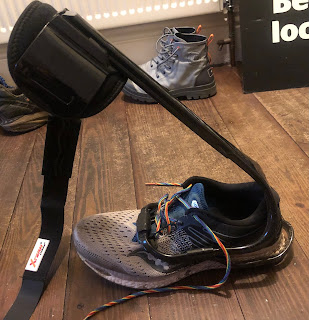
I suppose this is best illustrated in my running. I ran a bit before my diagnosis, but for whatever reason, started taking it a lot more seriously afterwards. I've run six marathons and countless other events since. My MS has weakened my left side and my left ankle is slowly losing its flexibility. This makes running harder, but thanks to the support of my MS team, I have been able to keep running using a series of different strategies, insoles and orthotic devices. The most recent of these is a pretty snazzy piece of kit that adds some spring-back into my ankle and seems to have stopped me from falling over.


Before this, I was falling over so often whilst running that I was beginning to cause myself some real damage. This brace works well enough that I've been able to go out running without wearing the wrist guards and kneepads.

 Even so, I'm basically fighting a losing battle. 

A consulant surgeon who specialises in sport (and who is a runner himself) told me about ten years ago that it probably wouldn't be my MS that ultimately stopped me from running; it was likely to be as a result of some of the compromises my body was being forced to make to compensate for weakness elsewhere. It seems that is likely to be the case for me. As well as the creeping stiffness in my ankle and the muscles of my leg, I'm told that the weakness in my left hip now means that my running gait has changed. Apparently, instead of driving my left leg through my running stride normally, I now "throw" it in front of myself because I lack the fine muscle control required. 

Running is hard and has got a lot harder over the last couple of years. My last marathon was in April 2019, and it now feels unrealistic to think that I could put my body through that kind of a distance, never mind the hundreds of miles of training. Perhaps more importantly, I'm not sure I have the kind of determination you need. Instead, I've found a joy in just being out and running at all. I can't run as far or as fast as I did before. Usually, at this time of the year, I'd be out with my club taking part in a local series of cross country runs. I've never been very quick, but they're very inclusive events and they are a lot of fun to run. There's a certain joy, I've discovered, in the mud and the hills. This year, I've sat them out. I just don't think it's realistic to put my body through that kind of stress and I'm just not confident that I'm strong enough to pick up my left leg over that kind of terrain for a 10km race.

All these things make me feel a bit sad, but I'm also determined to continue to focus on what I can do, rather than to dwell too much on the things I might have lost. 

I suppose this is what my neurologist means by acceptance.

He also told me that my MS progression was quite unusual: it is not at all normal for patients this far after their diagnosis to be as fit and healthy as I am (my first symptoms were in 2005 and my diagnosis was in 2009). This is obviously good, but it's also a bit depressing. Yes, I've been lucky, but I suddenly have a real sense that the sand is running out of my timer.

Over the last two years, my condition has progressed. I haven't really developed any new symptoms, but the symptoms I do have are getting worse and are affecting me much more in my daily life. I take drugs to help manage my bladder urges and I self-catheterise every night. I also take muscle relaxants to try and control the muscle spasms in my legs that have woken me up at night for a little while, but are now starting to affect the way that I walk and even make it hard for me to sit still in the evening. I walk stiffly and can feel that I swing my legs from the hip as I walk because I tire easily and don't have the strength to drive them through normally. I wouldn't be all that surprised if I needed to walk with a stick at some point in the relatively near future (I actually find walking a lot harder than running).

I am relentlessly positive about these changes, but that doesn't mean that they aren't on my mind. I am really disciplined about not allowing myself to wallow in where this journey might end. No one knows the answer to that one, whether they have MS or not. But.... it does make me a little bit sad.

I reckon I'm pretty strong and resilient, on the whole and maybe I am a shining example of disease acceptance...but these changes are still a lot to take in. 

Well, I'm doing my best.


Wednesday, 18 November 2020

marching on...


Long time readers will likely know a couple of things about me:

1) I like to run

2) I have been very lucky with my MS to be able to continue running.

I try not to take it for granted. I actually only really began taking my running seriously after my diagnosis. I think there was something in my head that made me more determined than ever to stay active. Multiple sclerosis is not something that I can really control; I can't change the way that my legs feel or the other ways that the condition is affecting me, but I do have some degree of control over my own determination to get out and to exercise. 

My first marathon was in 2015, and I've run six in total. My high watermark of this madness was between April 2018 and April 2019. In that time, I ran four marathons. At the beginning of October 2018, I ran the Chester marathon in a time of 3:58... that was a PB of something like 22 minutes. My last marathon was a glorious day spent accompanying my wife to a personal best at the Vienna marathon in April 2019. We got married in the city in 2007 and have some wonderful friends there, so it was a joy from start to finish. I haven't retired from running marathons and half intended to get one booked for 2020, but.... well, lockdown happened.

Actually, more than lockdown happened. MS seems to have taken more of a grip on me over the last few months. Since my symptoms first appeared in 2005, I've always had a certain level of loss of sensation/pins and needles in my legs and feet. It does feel weird to run on legs like that, but it's amazing what the brain gets used to. Over the years, I've increasingly had problems with cramp in my legs. Initially this was in my calves, but it's slowly spread so that I was getting muscle spasms in my thighs. There's also a fair amount of stiffness. I've been accustomed to staggering around a bit like an old man when I've been sitting at my desk for a while, but now this seems to be happening more and more often. After resisting for many years, I now take a very small dose of baclofen (a muscle relaxant) before I go to bed. I may need to start taking a higher dose soon.

I'm falling over a lot more too. The loss of flexibility in my left ankle and strength in my left side has always made me a bit prone to this. I drop my left side as I get tired and start scuffing my left foot, which leads to stumbles. This is happening more and more often, meaning that I now go out running wearing knee and wrist guards (my knees have taken a frightful pounding from this and are now sore most of the time). 

I could stop running, but I don't want to. In fact, although I might be running more slowly at the moment, I'm actually doing more miles in lockdown than I think I've ever done before. I managed about 1220 miles in 2019 and I've done 1382 so far this year with 7 weeks still to go. I'll probably go comfortably over 1500 miles for the year. I'm still capable of running more quickly, but my default pace now seems to be a rather sorry plod because I don't really trust my legs any more.

I'm not telling you any of this looking for sympathy. It's just that I'm starting to acknowledge something that I've tried to ignore for more than a decade now: my MS is progressing. The official shift in my diagnosis from relapsing-remitting to secondary progressive a few weeks ago was recognition of that simple fact.

My own sense of self and wellbeing is bound up in my ability to run. For better or for worse. I'm going to keep running. Of course I'm going to keep running. I'm just slowly starting the process of coming to terms with the fact that I'm not bulletproof and that I can't control the progress of this godawful condition.

 You adapt, though. What other choice do you have? I'll always have that 3:58 marathon, eh?

Friday, 18 September 2020

don't stop moving...


As they're obviously trying to keep (potentially vulnerable) people away from the clinic at QMC at the moment, I had my annual consultation with my neurologist over the phone today. Actually, it was a surprisingly effective way of doing it and was probably as helpful as any of the sessions I've had at clinic since I first started getting symptoms. 

The long and the short of it is that my disability has been slowly increasing over the last few months/years and today they've shifted my diagnosis from 'relapsing-remitting' MS to 'secondary progressive' MS. 

I think this sounds more significant than it is. Ultimately, it's just a label to describe the way my disease is progressing. Most people with MS have a series of relapses, each relapse bringing new symptoms and new problems which get a bit easier with time (without ever completely disappearing), before the next relapse arrives and starts the cycle again. Almost all the treaments for MS are designed try and slow down the frequency with which you have relapses, thus slowing the progress of the disease and increasing disability. There isn't a cure. 

I've never really had relapses and have just seen a slow, but steady increase in the severity of my existing symptoms. I haven't been on a disease modifying therapy for a couple of years now, so shifting my diagnosis is really only an acknowledgement of the way my MS seems to be progressing: I'm not expecting relapses, but I am expecting my legs to get stiffer (amongst other things). The shift closes the door to lots of treatment options, but may open the door to others. 

It's only a label... but at the same time, it can't help but feel like a significant moment. It sounds significant. 

Still, I have much to be thankful for: we're off on an 11 mile run tomorrow morning and I've run a little over 1,100 miles so far this year. Very little of that has been as fast as I would like, but I know that I'm still capable of running quickly when I really want to, and I was only a few seconds off my mile PB a few weeks ago. Whilst I now don't trust my legs to the extent that I won't go out without knee pads and wrist guards, running remains at least as important to me now as it ever has done and I cherish what I can still do. 

Every run, no matter how long or how fast, still feels like sticking two fingers up at this diease. Long may it continue.

Tuesday, 11 August 2020

be brave...

For as long as I can remember, I’ve been called cynical. Cynical, negative and pessimistic. For a time, I was called it so often that I almost believed it myself and began to build my sense of self around it. 

The cynic. 

To be honest, I’m not sure that this has ever really been the case. It certainly is true that, as a younger man, I would throw stones and would criticise without feeling the need to offer up anything constructive. I’m pretty sure I’m not alone in going through that phase. It’s also true that, when feeling frustrated or powerless at work (annoyingly often), I would sometimes deliberately seek to tear people down in a way that was ultimately self-destructive…. But I was young and stupid and I don’t work there anymore (which is probably just as well: some people choose never to forget the person you were fifteen years ago, even if you’ve long since changed). 

I think it probably boils down to this: I like to ask questions. These days, it’s usually to genuinely try to understand something because I’m curious. The problem is that lots of people don’t like to be asked questions; they don’t like to be challenged by someone because, if you don’t know the answers or you aren’t very secure in your opinion, it can feel as though you’re being criticised. No one likes to be criticised, right? I try not to be threatening about it, but nobody’s perfect and I’m probably not the finished article even now. 

I think my MS has changed me, actually. Or maybe it’s just revealed another side to my personality. Nobody knows what causes MS, nobody knows if it will progress for me or what my outcome will be. There’s very little that I can do to change any of these things. I’m not really one for serenity prayers, but I do think that this has taught me acceptance. To paraphrase Kipling, to meet with Triumph and Disaster and to treat those two imposters just the same. I’m calmer, more relaxed and better able to approach life on an even-keel (whilst also remaining perfectly capable of frothing in indignation watching the news. Nobody is perfect. My wife is doubtless scoffing as she reads this). 

What’s the point in being pessimistic? I’m well aware what MS might do to me and I know all too well what it’s already done. I simply don’t see how dwelling on either of those things does me any good at all. MS pages on Facebook seem full of people wrapped up in their own invisible pain and suffering. I don’t doubt that they suffer, but I simply don’t understand the attitude because I try never to allow myself to think like that. Perhaps that’s easy for me to say, but I hope it’s a philosophy that will stay with me, whatever happens. “The Road not Taken” by Robert Frost is one of my favourite poems; my interpretation of it is that you should never waste time regretting the path you didn’t take. 

They say that a pessimist is never disappointed. I think they’re always disappointed. Besides, I’m a runner, and as Kipling also said:

If you can fill the unforgiving minute 
With sixty seconds’ worth of distance run, 
Yours is the Earth and everything that’s in it, 
And—which is more—you’ll be a Man, my son! 

Well, I can definitely do that. Maybe not as fast as I use to be able to do it… but I can still do it.

Monday, 1 June 2020

if I surround myself with positive things...


It was World MS Day on Saturday.

I woke up at about 03:30 to find my whole lower body in spasm. from the muscles of my lower stomach down through my legs to my feet. I've been getting cramps in my legs for some time, but this is different, it's not a sudden clenching of the muscles but something that lasts for longer. It's not as intensely painful, but it is uncomfortable and has a halo effect that lingers in the muscles for some hours afterwards, as a deep-set stiffness in the muscles.

As I often do when this happens, I got up and walked very stiffly to the bathroom. This is partly to ease the muscles off, but also I'm now pretty entrenched in the habit of emptying my unreliable bladder when it is convenient. I catheterise myself every night before bed to ensure I sleep with a completely empty bladder and take a drug every day to help resist bladder urge, but as I was awake it was a way to kill two birds with one stone. It was already pretty light outside and the dawn chorus was really starting to get underway. It was really quite a lovely.

That done, I staggered back to the bedroom to try to get some more sleep, popping an ibuprofen along the way in the hopes of waking up with a bit less muscle pain.

This is my new routine.

We already know that the problems with my bladder are related to my MS: my brain isn't able to reliably empty my bladder completely, and I will often get the urge to pee even if I've only just been, whether my bladder is empty or not. It's likely that the muscle spasms in my lower body are MS-related too. There are drugs you can take to chemically relax these muscles and to try and get a good night's sleep, but I'm reluctant to take them. 

After all, I'm a runner.

Running keeps me sane. This was true before the lockdown, and it's doubly true now. My ability to get out of the house and clear my head on a run is precious to me. I'm probably getting slower as I get older, but the speed I run is not nearly as important to me as my ability to run at all. As things stand, I don't want to compromise the ability of my legs to carry me and so, if the spasms are the price I need to pay if I want to keep running... well, then it's a cost I'm prepared to pay.

Mind you, I have been doing quite a lot of running recently: I covered 145 miles in May, almost all of it side-by-side with my wife, who hasn't run as far in a month, even when she was training for her marathons. Quite a lot of this mileage has been slow, on stiff legs. Where the speed of my wife used to be our limiting factor, these days, it's more likely that she's waiting for me. It's not that I can't run fast any more - I'm doing at least one set of intervals a week where I try to let the brakes off - it's just that I'm really just happy to be moving at all; delighted just to get out of the house in this beautiful weather and to enjoy the fresh air and the flourishing spring around us.

On Saturday, after another couple of hours of sleep, I got up and went out for a 5km run. It wasn't fast and it wasn't pretty, but I like to think that it helped to stretch some of that stiffness out of my legs. Maybe, maybe not. Either way, it definitely made me feel better.

I was diagnosed with MS in 2009 after 4 years of symptoms. It's an incurable condition with uncertain outcomes, so it's a frightening thing to be labelled with. Maybe I'm one of the lucky ones, but I do firmly believe that MS only has as much control of your life as you allow it.

As this film from World MS day a few years ago shows beautifully, a diagnosis with multiple sclerosis does not have to mean the end. Life is what you make of it, and other cliches.


I think I'm much stronger and kinder now than I was in 2009, and I thank MS for that.

Friday, 3 April 2020

like a lead leaf scrapes the gravelled ground...

It feels as though a lot has happened since my last post at the end of February. How can it even be possible to write a catch-up post that encompasses everything that happened during the course of the longest month since time began?

I don't think I'm even going to try.

Suffice it to say that the big news around here is that I've finally shifted across to a mesh wifi system. I've been meaning to do so for some time because, although my broadband is fibre optic and in theory very fast, in practice it's handicapped by constantly dropping wireless signal and the need for endless router reboots. Well, those issues are firmly in the past, let me tell you.

... Oh, there's something else?

As the New Yorker so elegantly put it in their cartoon today:


A brief montage of my March, then: we went to Austria and had a lovely week skiing that became a bit weird when it became clear that everything was going to be locked down and things started to close. We made it home on the last day they were operating flights from Salzburg, and we've been in lockdown here pretty much ever since.  Luckily for me, the new job that I started at the beginning of March is home based, so I'm obviously well-equipped to remote work. I miss my running clubs and I'm not uploading sessions for the group I coach onto WhatsApp, but the fact that I can still go outside for a run once a day makes all the difference to the way I feel. If I couldn't run, I don't know what I'd do.

Isn't it weird watching how people come to terms with the restrictions and how, as a society, we seem to have moved from panic buying toilet roll and pasta to loudly judging other people for how well (or otherwise) they're sticking to what they perceive to be the appropriate social distancing guidelines/rules from the government and assessing how well other people understand the concept of 2m of social distancing.

I also can't be the only one to feel slightly uneasy about our slide into "hero" culture for those people who work in the NHS or for other critical services. It's lovely to hear people coming out at 8pm on a Thursday night to applaud these "heroes", but at the same time, the best way to recognise these people is to pay them properly and to make sure they have the right equipment, isn't it? The Health Secretary may wear an NHS pin badge on his lapel, but he is part of a party that has systematically starved the health service of the money it needs to run effectively.  Let's hope people remember that when this is all over and we're next at the ballot box. And don't get me started on that tool from Wetherspoons. As for the clapping itself, I'm reminded of the mentality that some people have towards the armed forces, as skewered by Larry David in Curb Your Enthusiasm.

Strange times.

On a positive note, I think the MS charities have been doing an amazing job trying to keep people with multiple sclerosis up to date on the latest thinking on how the virus might affect us. It's all very well to try and reassure people that many of those people dying are old or have an underlying condition, but that's of little comfort if you are old or do have an underlying condition. It's a strange feeling to think that, if I were to catch coronavirus and die, someone would shrug and say, "Yeah, well he had MS, so.....".

Here's a really interesting post on shift.ms about how suffering from a chronic health condition like MS actually prepares you well for this world of social isolation. 

"Compared to the rest of the population, we are all used to:

- Being stuck in limbo, nobody can ever tell us how long something will last and if it will be permanent, temporary, relapsing remitting or progressive.

- Living with uncertainty. We all know only too well that nobody can predict what the future holds for us and that we have to plan as best we can, but always live in the present."

Well worth a read.

Stay safe. We're living in interesting times.

Friday, 28 February 2020

Danger! High Voltage!

I had a consultation with the neuro-rehabilitation unit at a local hospital towards the end of last year. I was seen by a specialist registrar, senior neuro-physiotherapist and a senior orthotist. Quite the collection of experts. They've just copied me in on the report.

Two things caught my eye:

1) "On examination, this gentleman is tall at 6' 5"" -- note how many experts it took to notice this particular detail.

2) "We believe that running marathons and training to run the marathons might exacerbate some of his symptoms." -- Oh dear. Luckily, they weren't finished there -- "Therefore, our physiotherapist advised him to alternate different modes of exercise between running marathons".

This isn't really news to me. At least they're not daft enough to suggest that I stop running altogether.

I always used to swim a couple of times a week, but when I started running marathons in 2015, everything else kind of fell by the wayside. I've also done a particularly large amount of long mileage runs over the last 18 months as I completed 4 marathons between April 2018 and April 2019. That would probably put a strain on anyone's body, never mind one with bio-mechanical issues brought on my a loss of strength on one side.

Since the Vienna marathon in April last year, my monthly mileage has actually probably gone up a bit. Two other things have changed though: I'm not doing the really long training runs you need in order to train for a marathon; I"m also running a lot of my miles more slowly, either with the group that I coach, or with my wife. This is reducing the amount of strain I"m putting on my body.

I'm not saying that I'm never going to run another marathon. After dipping under 4 hours at Chester in 2018 it's true that my desire to run 26.2 miles faster has all but disappeared. Am I interested in putting in the work to shave a few minutes off that time? Not really. 3.45 doesn't sound much better than 3.58 to me. Especially when you consider how much work would go into finding that extra few minutes. So, I'm not interested in going faster, but I am perhaps still interested in running a marathon with my wife again.... Vienna in April 2019 was a joy from start to finish. I don't have anything planned this year, but I am doing a 15.6 mile trail race tomorrow at Belvoir, so we'll see.


One other output from that consultation with the neuro-rehabilitation unit in November was an appointment with the FES team in Derby, which I attended this week. For an hour or so, I had a device attached to my left leg that fires electric pulses down the leg to stimulate the flex in my ankle. It feels a bit like a TENS machine (if you remember them), and it looks like I might be able to borrow a unit for 6 weeks or so to see if it makes any difference to my running. In all honesty, this kind of device is generally used to help people who are essentially immobile to walk again, so it feels a bit gratuitous to strap it onto someone who is still capable of running a marathon... but we'll see. They seem interested to find out how it helps a runner. Watch this space.

223 miles of running so far this year with another 15 or so to come tomorrow before February is out. I ain't doing so bad.

Wednesday, 12 February 2020

you are the unforecasted storm...

As an addendum to the post below, I received a letter the other day from the neurologist. Apparently, my November 2019 MRI scan shows no evidence of new disease activity.

This is clearly excellent news.

From the very beginning, my MS hasn't seemed to follow the usual patterns. Although I have technically been diagnosed with relapsing-remitting multiple sclerosis, where patterns of disease activity are followed by periods of remission and partial recovery, my MS has always behaved a bit differently. Most of my initial symptoms can be traced to a single lesion in my cervical spinal cord, but I haven't had a clear relapse since that first one and I don't seem to have developed any new lesions (the scarring on the brain or spinal cord left by the inflammation). That said, although I haven't developed any radically new symptoms, I have seen a general (albeit fluctuating) worsening of the ones that I do have. Relatively speaking, compared to others, I'm doing great... but the disease has changed my life. As well as the muscular symptoms of weakness, numbness and pins & needles, I also now take a pill to manage bladder urge and self-cathertise every night to ensure that my bladder is completely empty before I go to bed (I'm also careful of the volume of what I drink after about 20:30 at night. No more last orders at the bar for me). These things are different from what they were when I first developed symptoms in 2005. I may not have visible signs of disease activity in my MRI scan, but you can now see them in the way that I walk.

I think what this shows us is how complex a condition multiple sclerosis is; how it's an umbrella term for a massively varying set of symptoms and presentations. It's a handy label to put on people, but every single person seems to experience the disease differently. It's amazing how much the doctors and specialists do know, but equally very clear how much they don't know too.

I'm doing well. There's no sign of new disease activity in spite of the fact that I've now been off all medications relating to my MS for a couple of years now. It was a risk to stop injecting the drug that may (or may not) have been slowing my disease progression, but for the time being, it seems to be a risk that has paid off.

Long may it continue.

In the 43 days of 2020 so far, I've run 155 miles. I don't have much to complain about.

Monday, 10 February 2020

we are standing on the edge...

Sometimes I wonder how much I let MS define my life. I see memes on various Facebook MS groups that talk of no one understanding their world of invisible pain, and I just don't relate to them at all. I appreciate that different people process things in different ways, but I've always thought that I'm exactly the kind of person who doesn't wallow in the fact that I have multiple sclerosis.

But is that true? Can it be true?

Taking only this morning, I've worried about whether or not I'm finding it harder to sleep at the moment, I've thought about my bladder and bowel function, I've wondered if my bad back is being caused by any of the pills I take, I've staggered around on stiff, cramping legs and dragged a stiff ankle up and down the stairs a couple of times, I'm typing right now with numb hands. Is it really true to say that I'm not letting my MS define me? Just because I'm not posting memes about it?

Probably, some of these things will have nothing to do with my MS. A few definitely are, but I have to remind myself again that I'm actually extremely fortunate with my MS: my symptoms are reasonably stable and all of the above has to be taken in the context of the fact that I'm planning to go out for a 5 mile run this evening and that I've run 145 miles so far this year. Alright, so I'm finding running a bit harder at the moment, but it's not as though I'm doing much less of it.

I try not to put every little thing I feel down to my MS, but it is inevitably a filter through which I view the world.

Maybe that's the most insidious symptom of them all.

Thursday, 17 October 2019

I'll be needing stitches...

I had a busy day last Wednesday. I think it's fair to say that, since redundancy, my days haven't seemed quite as busy as when I was working 11 or 12 hour days every day.... but last Wednesday was definitely a busier day than average: a hospital appointment first thing, an appointment to take one of my MyGuide clients out for a walk at lunchtime, an interview with the charity that are looking to appoint me as a trustee and then the second week of the short course on creative writing that I'm taking at Nottingham Trent University.  By the time I got home at around 9pm, I was very much looking forward to sitting down with my tea and watching a bit of disposable telly.

At about half ten, I popped upstairs during an advert break (we were watching Elementary on Sky+. so we could have just skipped forward, but I needed to grab something from the bedside table). As I rounded the top end of the bed, I was unscrewing the lid on my drinks bottle when I was suddenly falling. I think my legs gave way, but as my hands were busy, I didn't have any time to react to this before my knees hit the ground and my chin hit the bedside table.

There was a short pause as I gathered myself and did a quick mental inventory: what just happened? have I really hurt myself? I was naturally a bit dazed, and my immediate reaction was to feel my teeth to see if I'd knocked any of them out in the fall. They seemed okay, but my ears were really hurting for some reason. At this point, I realised there was blood coming from somewhere, so I headed to the bathroom mirror to assess the damage. Through the beard on my chin, I could see a gaping cut. It wasn't more than an inch or so across, and it wasn't pumping blood, but it looked pretty deep.

Balls.

By now, my wife had rushed up the stairs to see what all the noise was about, and together we applied pressure to the cut and tried to work out what we needed to do next. It was tempting to do nothing and to just try and cover up the cut and go to bed, but I'd had a pretty nasty bang and the cut looked pretty deep, so we settled on calling 111, the NHS urgent care hotline. The operator on the other end of the line methodically ran me through the concussion protocols and then tried to assess the cut. I was coherent and seemed to be okay, but we agreed that the cut likely needed stitches and I probably needed to an x-ray. They passed my case on to the A&E department at QMC and told us to get there within the next hour.  It was a pretty efficient process and this call effectively acted as the triage for the hospital, and once we got there, all we had to do was to wait our turn. But there's the rub: we got there at about 23:30, and the screens were showing an 8.5 hour wait.

So we waited.

On my way back from my class, I'd wandered through town at about 20:30 and marvelled at the packs of students in fancy dress marauding through the city on their way down to Ocean. They were quite the spectacle, many wearing nothing more than a pair of speedos, and most of them being extraordinarily drunk for such a relatively early hour. As things worked out, I now saw several of the same people at the other end of the day, arriving at A&E covered in blood. Not a great way to end the evening, but most of them seemed in good spirits. Literally, I guess.

The staff were brilliant.There just weren't enough of them. One doctor and maybe three nurses for the whole department (there was another doctor, but he was called away). What made things worse was that several of the people waiting were clearly suffering from various mental health issues and were there because they simply didn't have anywhere else to go. It's heartbreaking to watch people sitting there with problems that an accident and emergency ward is never going to be able to fix. The staff are amazing, but they can't work miracles and they've been handicapped by a decade of austerity.

By the time we got actually seen by the doctor at about 6am, I was staggered by how cheerful he was, and how, even 11 hours into his shift, he was still looking for blankets to give to some of the shivering students. I was examined, X-rayed and stitched up. The A&E doctor thought he saw a fracture, so I was referred up to the Head and Neck ward, which was just opening up for further consultation. The consultant there explained to me that he was fairly sure that I didn't have a fracture, but because the A&E doctor had documented one, they needed to be super careful to rule it out. Did I mind waiting for a CT scan? Ah, what the hell. What's another couple of hours when you've already been there for ten?

So we waited. We had enough time to get a coffee and something to eat, but then it was the scan and a final consultation to hear the news that I almost definitely didn't have a fracture. They were worried about what's called a "Guard fracture", apparently: named after what happens when a sentry faints at his post and lands directly on his chin, causing fractures on the point of the chin and on the hinge of the mandible on either side (which is why the ears hurt).  I left the hospital with a sore jaw and a couple of stitches, but the feeling that I'd been really very lucky indeed not to have anything worse. A fracture might easily have involved extensive surgery and pinning.

It was a very, very long day.

The thing that I really don't want to think about is *why* my legs gave way. I think we probably know why, don't we? I've an underlying weakness in my legs, especially my left leg, that has been getting worse and worse recently. I've been moaning for a few months now how much harder running seems at the moment. I guess this is another thing that can happen. 

Understandably, I don't really want to dwell on this. I appreciate that something like this can cause as many mental problems as physical, but I really don't want to live my life like that. Maybe it's excessively stoical of me, but who wants to live their life like that?

Mad props to my wife for helping to pick me up and then spending a long, uncomfortable night at the hospital before heading off to work once we got home. I just went to bed, but she's hardcore.

Wednesday, 2 October 2019

slow down...

Let's not make any bones about it: I've been lucky with my MS.

Sure, I have some problems: numbness, pins & needles, muscle weakness and wastage, spasms, bladder issues, fatigue... but when it comes right down to it, I've run 6 marathons since I was diagnosed in 2009 and I still go out running 5 or 6 times a week. In the grand scheme of things, my problems are small.

Just recently though, things have been getting a bit worse and are really starting to affect my running. I was warned years ago that this day might be coming: a consultant specialising in sports medicine told me nearly ten years ago that it probably wouldn't be my MS that stopped me running directly, but it would probably be something caused by my MS. This doctor was a runner too, and he'd recently had to stop running because of back surgery, so he was quick to spot how important running was to me and quick to realise how critical it was to keep me on the road. He understood. To be fair, he also said that I would probably never run more than 10km again, so he clearly didn't know everything.

Perhaps he was just a few years early with his prediction.

I've been steadily losing flexibility in my left ankle for a while now but it's become quite stiff over the last couple of months and the achilles is very tender; I've had stiffness and numbness in my legs almost since the very beginning, but it's now taking me a mile or two to shake it off and get into my running stride; the muscle loss in my left side has been apparent for a while now, but I'm now getting niggles across my core and on my right side as my body tried to compensate.

I ran four marathons between April 2018 and April 2019. I'm still running around 25 miles per week and have run just short of 1000 miles in the calendar year to date. It feels ridiculous to complain because I've sat in enough MS clinics to know what this disease can do and how lucky I've been.

... but still, it is upsetting. I was hoping to run another marathon in spring 2020, but at the moment, even a half marathon feels like a bit of a stretch goal. We're almost exactly 12 months since I ran a half marathon PB (at Tissington) and a marathon PB (at Chester) in successive weeks.  It feels so frustrating to find my mileage restricted by a failing body.

Still, although it's frustrating, I hope I'm wise enough to realise that slowing down a little isn't the end of the world (even if it might feel like it is). That doctor was right: running 10km slowly is a lot better than not running at all.

Dangnabbit.

A runner just wants to run.

Tuesday, 6 August 2019

big wheel keeps on turning...

I was at the physio yesterday.

I ran four marathons last year and I've run 782 miles so far this year. Given that I have a chronic, incurable neurological condition, I suppose that it was only really ever going to be a matter of time before I needed a bit of maintenance.

I'm currently seeing various specialists about various ailments, but my visit yesterday was to consult with an expert about a sore achilles tendon on my left side.  I tend to have a rolling list of things that bother me when I run, and this sore tendon has worked its way up to the top of the list over the last few months, overtaking a stiff ankle and finally moving its way past my previous number one concern of very sore internal oblique muscles. Yeah, it's a laugh a minute keeping this show on the road, let me tell you. I was hoping that I'd be able to get some easy answers and some quick treatment to push this back down the list.  Sadly, this isn't quite how the session worked out.

You will not be in the least bit surprised to know that all of these complaints are apparently connected. As I sat down to talk through my reason for booking the session, the physio looked at the side of my left knee and pointed out that my tendon there looked like it was substantially wasted. Indeed, when I looked, you can see a hollow developing where it used to be. He also admired the fact that there was noticeably less muscle on my left hand side compared to my right and moved down to examine my ankle.  Oh, look at this.... you've got almost no strength here compared to the other side and your tendons have got about twice as much slackness as they're meant to, meaning that I have very little control at all over the lateral movement of my foot, which is why I fall over a lot as I lose control of my foot and my ankle rolls.

He's shown me a load of exercises to do to try to build up the strength of my left ankle, but I left feeling a little down about the whole thing. A sports specialist told me ten years ago that it wasn't likely to be the MS that stopped me running, but that it was probably going to be some underlying, secondary issue caused by the MS. This looks like the way it's going to be.

I'm a stubborn old bastard and it will take a lot to take me off the road... but it's always sobering to have your own physical decline spelled out to you. No matter how much I like to pretend otherwise, I'm not entirely like other runners and my performance isn't linked to how hard I train or how much I want it.

I've got an appointment at the musculoskeletal clinic next week. I'm hoping that I'll get some proper bio-mechanical assessment done to see if there's anything more that can be done to help keep me out and running... be that orthotics or whatever. In the meantime.... I've got a 10km club trail race tomorrow to keep me busy and to both take my mind off and to focus it intently on my physical shortcomings.

Wednesday, 10 July 2019

you're an embarrassment...

So, I've started doing the Neil Gaiman Masterclass on storytelling. Each chapter comes with a workbook and a writing exercise. I'm not sure if I'll be posting them all, but here's the one I wrote from the "Truth in Fiction" chapter.

A time when I was deeply embarrassed

As you write, pay attention to your inner register about what you’re writing, noting the particular things that make you uneasy. Try to be a little “more honest than you’re comfortable with.” Remember that being brave doesn’t mean you’re not scared; it means you do it anyway.

A few years ago, I went back to my old school. I would say that, on the whole, I have an uneasy relationship with my schooling. It’s not that I don’t have fond memories of much of that time, because I do. I’m just embarrassed by it: I’m embarrassed that I received a private education and I’m embarrassed that I haven’t exactly taken advantage of any of the opportunities it might have presented me. My parents both came from fairly humble backgrounds and worked hard. They wanted their children to have the best possible education and were happy to sacrifice holidays and other luxuries so that they could afford it. What this meant for me is that I spent eleven years of my life at boarding schools. At the age of seven years old, I effectively left home in pursuit of this brighter future. I learned lots of things in this time, and I’m sure that it has afforded me many advantages in life. I’m privileged. I also think that it robbed me of a closer relationship with my parents and damaged my ability to form meaningful emotional connections with other people. I once mentioned to my mother that I would not send any children of my own to a private school and she cried. She only wanted the best for me and it must have been intensely difficult to send her young, vulnerable seven year-old son away to school and it was very upsetting to hear that same son effectively rejecting those decisions and those sacrifices.

I generally avoid reunions like the plague and I’m not sure what I expected from this one. I met various teachers and old school friends, but it was the smell of the place that really took me back. All it took to throw me back in time was the smell of the place, the changing rooms, the dormitories. They smelt exactly the same, and the scent brought the memories flooding back of the seven-year-old boy teased for his crooked teeth, his glasses and his puppy fat. No matter how thin I get, somewhere inside me is that child teased for being fat. I wasn’t fat then and I’m not fat now, but the damage was done. I can still remember some of their names. They would be fifty by now, and they were only twelve years old then, but I remember them, and I remember the way their teasing made me feel. The funny thing is that, in spite of everything I never really felt homesick, even in those early weeks. I feel guilty about that too. I suppose that’s the kind of self-reliance and stiff-upper lip that the British Empire was built on. You don’t get to rule over most of the world by talking about your feelings, do you?

On the very last day of my first term, we had a carol service in the village church. It was only a short walk away from the school, and the whole school processed there, all dressed up in our Sunday best and our bright, yellow ties, neatly scrubbed and brushed to within an inch of our lives for the set piece finale to the term. It was a very traditional, church of England kind of a carol service with the traditional songs and some readings: Once in Royal David’s City, The First Noel, O Come All Ye Faithful. You know the drill. In later years, I would be a member of the choir and would play a much more active part in the service, but this year, I was just one of the smallest members of the congregation and sat on a pew in the cheap seats. I don’t imagine that the service was very long, but at some point, I remember I began to feel the urge to pee. What started as a gentle nagging thought soon grew and grew until all I could think or feel was this terrible, burning necessity. Of course, there was absolutely no question that I could get up and leave the chapel. How could I? Everyone would be watching. Even if I did, what was I supposed to do next? I couldn’t just walk back in and take my seat, could I? I’m not entirely sure I’d know what to do if this happened to me now, but I definitely didn’t know what to do as a seven-year-old, so I sat where I was and felt this quiet desperation building inside me.

Somehow, I held on and eventually, the service ended and we all made our way back towards the school to be picked up by our parents for the start of the Christmas holidays. I can remember rushing out as fast as I could and making my way down the path through the woods that led back to the school. It was a dark December evening and there was no lighting through the trees, but I could see the lights of the school twinkling a few hundred meters away. I hurried along, probably pulling on the end of my penis, as little boys do and hoping somehow to make it back before it was too late. I can still vividly remember the moment I knew that I wasn’t going to make it back: I hadn’t managed to get very far from the church when I stopped dead in my tracks and my just bladder relaxed. I experienced an immediate relief, followed at once by a spreading sense of warmth and wetness in my pants and down my legs. Of course, the shame quickly followed. No one was there to see me, but this had now happened to me and surely couldn’t be kept hidden. I was seven years old, nearly eight. I was much too old for this to happen to me and now I’d made a mess of my best school trousers. I was going to be in trouble for this. Worse, I was going to be laughed at for this. I can remember running the rest of the way back to the school and heading straight up to my dormitory. I’d travelled so fast that I was the first person back, so I quickly stripped out of my sodden clothes and changed into the clothes I would wear to travel home. Without really thinking, I dropped the soiled clothes into the laundry basket and went home for Christmas. I did not tell a single person what had happened. From that day to this, this has been my secret.

I sometimes think about that. Presumably the person processing the laundry would have found it hard to miss the piss-soaked trousers? Heavy and wet and stinking of urine as they must have been. Like all my school clothes, they were also marked with my name and my school number, so how could this secret be kept hidden? Someone must have known what I’d done. Surely they would tell someone else and the game would be up and my humiliation would be certain. And yet no one said a word. At least, not to me. At the start of the next term, those clothes were clean and dry and folded with the rest. So I kept my embarrassment silently to myself from that day onwards, never knowing if anyone else knew. Perhaps they did and they just didn’t care.

That day wasn’t even the last time that I wet myself. After my diagnosis with multiple sclerosis, I’ve experienced a few issues with my bladder and I now catheterise myself on a regular basis to make sure that it has drained properly. There’s something richly ironic about this because, amongst my friends, I’ve been famous for having a weak bladder for most of my life. I’ve always been the one amongst us who needs to go to the loo most often. I don’t know if I actually do have a particularly weak bladder, to be honest. Maybe. Actually I think it’s entirely possible that I simply developed a compulsion to take every possible opportunity to empty my bladder because of that night in the winter of 1981.

Monday, 8 July 2019

he just stares at the world, planning his vengeance....

Within my own personal social media echo-chamber, I follow a number of MS-related pages and blogs: some of the main charities, but also a few interesting individuals too (hi Steve!). At their best, they are an excellent way to keep up to speed with the latest news and developments,  but they're also a good way of getting some basic, nuts-and-bolts factual information about multiple sclerosis. Of course, as with any other form of social media, you have to wade through huge amounts of memes and other unsubstantiated nonsense from the great unwashed to get to the good stuff.  If you haven't got a finely tuned bullshit filter up and running by now, then you should probably just stay well away from the internet for your own safety.  Still, if you do have the patience and a modicum of critical appreciation, then you can pretty quickly find the nuggets of gold of helpful information and a support network of organisations and individuals ready and willing to offer you support. If you know what you're looking for, then you really don't have to go through this alone. This is one of the things that the MS Trust is fantastic at... providing unbiased information and support to people with MS or going through the process of diagnosis.

There is an awful lot of old toss out there, though.  My own personal bugbear are the pity parties, the people who use these forums as a way of wallowing in their own world of personal pain. There's one guy on the MS Trust pages who posts a different "no one understands my suffering so don't judge what you don't understand" memes every single day. Every. Single. Day.  He must have a folder on his desktop where he saves them down when he finds them from his google alerts so he can quickly publish them every morning. I suppose he's looking for validation and a bit of human engagement, and he gets it in spades.  Every post is re-shared and filled with comments from people saying "so true, so true".  Look.  I get it, I really do.  MS is one of those conditions where people can get isolated and where increasing levels of disability must make the temptation to mourn what you've lost impossible to resist. It's also easy for me to judge when I'm able to run marathons.

But that's the thing, isn't it? I can run marathons, but that doesn't mean that I haven't suffered as a result of my multiple sclerosis. I ran before my symptoms and diagnosis, but I had only done one or two half marathons. I had no idea that running was going to form such a central pillar to my life, nor that my body was going to be robust enough to stand finishing 6 marathons (to date), including one that dipped under the 4 hour mark. These things seemed impossible to me before my diagnosis, but that diagnosis somehow gave me a strength and determination to try these things and not just to lie down and be beaten.  I'd like to think that, even if I couldn't run marathons, or if something happens that means I can no longer run that far, then I'll find something else to focus on instead. 

Starting with parkrun, I've discovered a joy in volunteering. Now, as well as happily volunteering most Saturdays, I also give up my time to coach as Couch to 5k programme at my running club, and when the first batch graduated, I started coaching an Improvers group too. I've got enormous satisfaction from watching these guys go from C25k to pulling on their club vests and racing 10km races for their club.  My point is that something made these guys get up off the couch and to start running. If they're anything like me, they have a little voice in their head that is constantly questioning what the hell they think they're doing running around a track with all these excellent runners; that they don't belong and that they look ridiculous. Like me, they've faced that fear and done it anyway, and now there's no stopping them. It would have been a lot easier to stay on the sofa and say that they couldn't possibly ever do these things, but instead they've taken the harder path and faced down their fears. 

MS is similar, at least in my experience.  Sure, not everyone is going to be able to run, but there's always going to be something else you can do to stop yourself wallowing in your own suffering.  Or, even worse, projecting that suffering at other people.

The other day, someone on the MS Trust Facebook page published a link to a story on the BBC website about someone with MS who completed an Ironman triathlon.

Conor Devine - the Ironman with MS

Here's the comment she put up to accompany the link:

"This is fab for him, but makes me angry. I am just going to sit here and try really really hard to overcome optical neuritis or trigeminal neuralgia for all of us. I am so pleased he can do this, but I (we) can not go out and improve our mobility more than we can. This implies to the world that we could be well if only we tried. Pleased for all of you who can do any degree of activity to keep you fit, some can’t. If it had just said that"

Someone else felt the need to add, 'Great now the dwp will think we can all do this'

Now, the BBC could definitely have done a better job in that piece of making it clear that MS has a variety of possible outcomes, and that completing an Ironman probably puts you at one extreme end of the scale.... but I find it so difficult to stomach the wilful tunnel vision displayed by this kind of attitude, an apparent inability to share in someone else's successes and a determination to wallow in their own limitations.  I once received a comment (here or elsewhere) from someone else with MS saying something along the lines of "There's always someone like you, climbing a mountain or running a marathon when I can't even run for the bus". Why can't we just revel in these successes? Where's your generosity of spirit?  Someone else's success doesn't reflect on your own failures, does it? Why try to limit your expectations to a world of what you can't do and not think upwards towards what you might be able to achieve instead?

It's a cliche, but you really don't know what you might be able to achieve until you try. Sure, you might not be climbing a mountain or running a marathon, but who knows what you might be able to achieve instead?

I'm doing my training with Guide Dogs tomorrow, so I'm about to embark on another chapter in my volunteering. It would be a lot easier to do nothing and to stay at home instead, worrying about the progression of my MS and how no-one understands my invisible pain, but I'm trying to do something useful with my life instead.

I'm not dead yet.

Thursday, 7 June 2018

uptight, out of sight...

Like most kids who grew up in the 1970s and early 80s, I have vivid memories of a gentleman by the name of Joey Deacon. Joey suffered from cerebral palsy, and in 1981, the International Year of the Disabled, he was the focus of a feature on the children’s TV programme, Blue Peter as an example of someone who had achieved a lot with his life in spite of his disabilities. Of course, kids being kids, the term “Joey” and the phrase “Spaz” immediately became shorthand for someone who was stupid… so much so that the Spastic Society changed their name to “Scope” (which obviously led to kids adopting “Scope” as their new insult for a stupid person).

I’ve had cause to think about spasticity quite a lot recently. Although I’ve been pretty lucky with my multiple sclerosis, one of my most persistent symptoms has been stiffness and cramping in the muscles of my legs. I’ve actually had a physio film my calf muscles as he couldn’t quite believe how much the muscles seemed to pulse and ripple of their own accord. The rippling itself seems fairly benign, but I also get night cramps in my legs, quite often waking up on agony. Mostly, this is confined to my lower leg, but the stiffness and the occasional twitch has spread up into my thighs, much to the irritation of the cat when she’s trying to get comfortable. I’ve been diagnosed some baclofen to help combat these cramps and twitches and the muscle stiffness, but as a runner, I’m a little bit wary about taking any sort of muscle relaxant: it might help me sleep, but what about the impact on my muscles when I don’t want them to be relaxed? Perhaps the acid test for me at the moment is that I’d rather put up with the cramps and the stiffness than risk anything which might have a knock-on affect on my running.

My MS is technically classified as relapsing-remitting, but I couldn’t honestly tell you of a single defined relapse. Instead, I seem to have a set of symptoms that seem to be fairly steady but slightly on a downward trajectory. By running two full marathons in a thirty day period, as well as the hundreds of miles of training, I know that I’ve asked my body to do a lot this year. It probably wouldn’t be all that surprising if the increased spasticity in my legs that has me staggering around like an old man whenever I get up from my desk at work is related to that. That’s quite a lot for anyone, never mind someone who suffers from multiple sclerosis and I need to be mindful that my body needs to rest, no matter how much I want to be out there flogging it. If my body wants to let me know the consequences of what I’ve done, then that’s probably fair enough. That said, I’m actually considering entering another marathon in October, so now is very much the time when I have a window of opportunity to rest up a bit before my training starts up again in earnest…. I’m hoping that the muscle stiffness is going to ease off, but let’s be honest: I’m not going to let it stop me one way or another until I can’t even manage a shuffle.

Meanwhile, I’ll just keep reminding myself how lucky I am when I feel like cursing my stupid, failing body.

Wednesday, 30 May 2018

roll with the punches...


I seem to have lost my ability to jump.

How did I discover this?  Because it was jumps night up at the track.

I now spend my Tuesday evenings helping coach the kids up at the track with my running club.  Mostly, it's crowd management and trying to use the hour we have to wear them out before we hand them back to their parents.... but we also try and introduce them to the rudiments of the various athletic disciplines.  Yesterday was jumps. 

As well as introducing the kids to the delights of the long jump pit, we did some standing jumping.  As pictured above, that's putting both feet together, jump up onto the top of the mat, jump down... repeat with bigger and bigger mats.  Sounds easy, right?

Well, the kids certainly made it look easy.  Some of them could jump up to almost their own height.  Pretty impressive.

Me?  Well, I discovered that my ability to jump up more than about 6 inches has essentially just disappeared.  Maybe this is due to the fact that my body is still a bit battered and sore from running two marathons in the last few weeks (which it most definitely is - it's taking my knees about two miles into a run to warm up at the moment!). Unfortunately, I think it's also probably something to do with my general loss of muscle and flexibility thanks to my MS.

Is standing jumping something that I'm likely to miss?  Not really.  After all, I only noticed I couldn't do it when I was trying something that I probably haven't done at all in the last 35 years.... but even so, it still seems like a tangible marker of something that I used to be able to do that I now can't do. 

As I can run a marathon, perhaps I have no right to grumble, but still...  I like to pretend I haven't been affected by MS much at all, or at least try to ignore it most of the time.

Sometimes though, it just makes its presence felt.

Monday, 14 May 2018

upside your head...


Throughout my adult life, I have often been accused of being cynical.

I actually don't really agree with this assessment at all, but I've probably only got myself to blame.  I prize critical thinking very highly indeed, and I'm also blessed with an almost complete inability *not* to say what's actually on my mind.  On the rare occasions that I have been able to keep my mouth shut and my opinions to myself, I have sadly been unable to keep exactly what I'm thinking from being easily readable on my face.

I admire this quality in other people, but I have to say that it hasn't been particularly good for my career.

Anyway.  Safe to say that I don't think I'm generally seen by people as a glass-half-full kind of a guy.

Until recently.

I was speaking to someone that I've known for more than a decade the other day, and he was genuinely taken aback when I suggested that I was a cynic.  He seemed to think that I was pretty much the case-study of an optimist.

I'm sorry...what?

Well, how else did I explain my attitude to life since my diagnosis with MS and the fact that I started running marathons?

Now I was taken aback.  I've been called lots of things over the years, but I don't think anyone has ever accused me of optimism before.

Well, it's been a little over three weeks since I ran the hottest London Marathon ever.  Since then, I've been managing a dodgy ankle, a black toenail (incredibly the first one in my running career!), a strained glute muscle, a sore knee, a possible inguinal hernia and a nasty lingering cough.

Oh, and MS.

This coming Sunday, I'm going to be running the Liverpool Marathon on what is apparently forecast to be the hottest day of the year.

If that isn't optimism, I'm not sure what is.

Well, what's the worst thing that can happen?

Wait.. don't tell me.

Thursday, 19 April 2018

hot, hot, hot...

I'm suddenly feeling a bit emotional at the thought of running a marathon on Sunday.

I've run this marathon twice before, so I'm not intimidated by the distance and I know I've put the hard work into my training. I've run the hard yards through a pretty brutal and relentless winter and know that I've earned my place at the start of what looks like it might be the hottest London Marathon on record (typical, right? You train through the Beast from the East and end up running in a heatwave).

I'm feeling emotional because I've been humbled again by the generosity of the people donating money on our fundraising page. Our friends, family and lots of total strangers have been dipping their hands into their pockets and have nudged us towards a fantastic total -- currently over £7,000 before gift aid. The MS Trust is a fairly small charity, but the impact that they have on the lives of people with multiple sclerosis and their families is massive. I was attending an MS clinic the other day, and the nurse that I saw was trained by the MS Trust (many others are also partly funded by the Trust), and the leaflets I was given to help me with some important decisions were funded and produced by the MS Trust. The money that we raise here will make a genuine difference.

As usual, I've deployed my tired old sob story in an attempt to emotionally blackmail people into donations. In 2016 I was an official London Marathon blogger, but this time around, my story was picked up by the Daily Mirror and run both online and in the printed edition. This has been more than a little surreal, not least because the bottom 25% of the page I'm featured on tells the story of someone running the marathon without functioning kidneys.


As well as helping me give people another nudge towards our donation link, this sort of exposure is so important for the charity in helping them to increase their reach. It was a little weird to see myself in a mass circulation tabloid, mind. They describe me as "fun loving Tim", possibly because I'm wearing a tutu.

I'm obviously not shy about deploying my story like this, but it's strange to see people talking about how remarkable I am, how my PB is "Brilliant" (well, I'm hoping to beat it this year, for starters...weather permitting). I don't feel particularly inspiring or amazing.

I mostly just feel lucky.

My race number for Sunday is 24120. Look out for the tall, skinny chap in a blue tutu.

You can sponsor us here: https://uk.virginmoneygiving.com/Team/TCK