Showing posts with label remember. Show all posts

Sunday, 11 November 2018

never forget...


Vergissmeinnicht

Three weeks gone and the combatants gone
returning over the nightmare ground
we found the place again, and found
the soldier sprawling in the sun.

The frowning barrel of his gun
overshadowing. As we came on
that day, he hit my tank with one
like the entry of a demon.

Look. Here in the gunpit spoil
the dishonoured picture of his girl
who has put: Steffi. Vergissmeinnicht.
in a copybook gothic script.

We see him almost with content,
abased, and seeming to have paid
and mocked at by his own equipment
that's hard and good when he's decayed.

But she would weep to see today
how on his skin the swart flies move;
the dust upon the paper eye
and the burst stomach like a cave.

For here the lover and killer are mingled
who had one body and one heart.
And death who had the soldier singled
has done the lover mortal hurt.

Keith Douglas

--

100 years on, and the old lie is still doing pretty good business.

Dulce et decorum est
Pro patria mori.


Don't just remember. Learn.

Friday, 11 November 2016

swear by the green of the spring that you'll never forget...


Aftermath by Siegfried Sassoon.

Have you forgotten yet?...
For the world's events have rumbled on since those gagged days,
Like traffic checked while at the crossing of city-ways:
And the haunted gap in your mind has filled with thoughts that flow
Like clouds in the lit heaven of life; and you're a man reprieved to go,
Taking your peaceful share of Time, with joy to spare.
But the past is just the same--and War's a bloody game...
Have you forgotten yet?...
Look down, and swear by the slain of the War that you'll never forget.

Do you remember the dark months you held the sector at Mametz--
The nights you watched and wired and dug and piled sandbags on parapets?
Do you remember the rats; and the stench
Of corpses rotting in front of the front-line trench--
And dawn coming, dirty-white, and chill with a hopeless rain?
Do you ever stop and ask, 'Is it all going to happen again?'

Do you remember that hour of din before the attack--
And the anger, the blind compassion that seized and shook you then
As you peered at the doomed and haggard faces of your men?
Do you remember the stretcher-cases lurching back
With dying eyes and lolling heads--those ashen-grey
Masks of the lads who once were keen and kind and gay?

Have you forgotten yet?...
Look up, and swear by the green of the spring that you'll never forget.

---

Somehow, this poem is made all the more poignant by the knowledge that Sassoon survived the war and lived to be 80.

In 1939, he got to see it all happen again and to see exactly how much we had forgotten.

We keep forgetting.  We say we don't, but we do.

---

I've tried hard to rise above it this year, but to illustrate again how often I get exercised by the idiots that surface at around this time of year, and in honour of this evening's England v Scotland match, here's a post on the subject of poppies and football.  I wrote it initially in 2009, posted it again in 2011 and could pretty much just as easily put the whole thing up again this year.

How about we just try and pay quiet tribute to the fallen without trying to score points about how much more we care than anyone else?

Thursday, 10 November 2016

ardent for some desperate glory...


I’m conscious that I tend to only post war poetry of the “boom, boom, boom” variety. I suppose the more optimistic stuff doesn’t really fit with the view of the First World War that I’m looking to portray. When we think about “the war to end all wars”, we tend to think of the horror of the trenches and the senseless deaths of all those men walking through No Man’s Land into the machinegun fire.

“Dulce and Decorum Est” seems to be a million miles away from the romantic optimism of Rupert Brooke’s “The Soldier”. The one was written in 1914 and romanticises a soldier dying for his country; the other was written in 1917 and captures the brutal reality of trench warfare.

The Soldier, by Rupert Brooke

If I should die, think only this of me:
That there’s some corner of a foreign field
That is forever England. There shall be
In that rich earth a richer dust concealed;
A dust whom England bore, shaped, made aware,
Gave, once, her flowers to love, her ways to roam,
A body of England’s, breathing English air,
Washed by the rivers, blest by the suns of home.
And think, this heart, all evil shed away,
A pulse in the eternal mind, no less
Gives somewhere back the thoughts by England given;
Her sights and sounds; dreams happy as her day;
And laughter, learnt of friends; and gentleness,
In hearts at peace, under an English heaven.

This sentiment seems somewhat at odds with Owen’s most famous poem.

Dulce et Decorum Est, by Wilfred Owen

Bent double, like old beggars under sacks,
Knock-kneed, coughing like hags, we cursed through sludge,
Till on the haunting flares we turned our backs
And towards our distant rest began to trudge.
Men marched asleep. Many had lost their boots
But limped on, blood-shod. All went lame; all blind;
Drunk with fatigue; deaf even to the hoots
Of tired, outstripped Five-Nines that dropped behind.

Gas! GAS! Quick, boys! - An ecstasy of fumbling,
Fitting the clumsy helmets just in time;
But someone still was yelling out and stumbling
And flound'ring like a man in fire or lime ...
Dim, through the misty panes and thick green light,
As under a green sea, I saw him drowning.

In all my dreams, before my helpless sight,
He plunges at me, guttering, choking, drowning.

If in some smothering dreams you too could pace
Behind the wagon that we flung him in,
And watch the white eyes writhing in his face,
His hanging face, like a devil's sick of sin;
If you could hear, at every jolt, the blood
Come gargling from the froth-corrupted lungs,
Obscene as cancer, bitter as the cud
Of vile, incurable sores on innocent tongues, --
My friend, you would not tell with such high zest
To children ardent for some desperate glory,
The old lie: Dulce et decorum est Pro patria mori.

The optimism of 1914, it seems, is long dead by 1917/18.  Brooke himself died in 1915 whilst en-route to Gallipoli… perhaps not quite the heroic and glamorous death he imagined for himself: sepsis from an infected mosquito bite...but, in spite of this, he was almost immediately eulogised in England as the first poetic martyr of the war.  Winston Churchill himself even described Brooke as "all that one could wish England's noblest sons to be".

Our own views of the “Great War” are now indelibly bound up with the work of the trench poets like Owen and Siegfried Sassoon – it’s impossible to imagine that a programme like Blackadder Goes Forth - with that famous, poignant last scene of poppy fetishism - could have been made without them. Actually, optimistic poetry about the First World War was written throughout the course of the war. The trench poets tend to be the ones that we remember now, but they were very much in the minority at the time. We might find it hard to imagine when we look at what they were fighting for, but those involved didn’t like to think that they were dying for nothing and preferred to see themselves caught up in a more noble struggle; their betters knew what they were doing and wouldn’t be asking them to die for no reason, right?

Charles Carrington, a survivor of both the Somme and Passchendaele was moved to write, "Just smile and make an old soldier's wry joke when you see yourself on the television screen, agonised and woebegone, trudging from disaster to disaster, knee-deep in moral as well as physical mud, hesitant about your purpose, submissive to harsh, irrelevant discipline, mistrustful of your commanders.  Is it any use to assert that I was not like that, and my dead friends were not like that, and the old cronies I meet at reunions are not like that?"

It's funny how history can be warped over time, isn't it? What you think you know isn't ever really the way it was.

Anyway.

I look around at our “Help for Heroes” culture, where every soldier who has served is a hero serving their country in a just cause, and I do wonder if history has taught us anything.

You don't have to look far to see that the old lie is still very much alive and well today. Dulce et decorum est Pro patria mori.

Wednesday, 9 November 2016

bonds to the whims of murder...


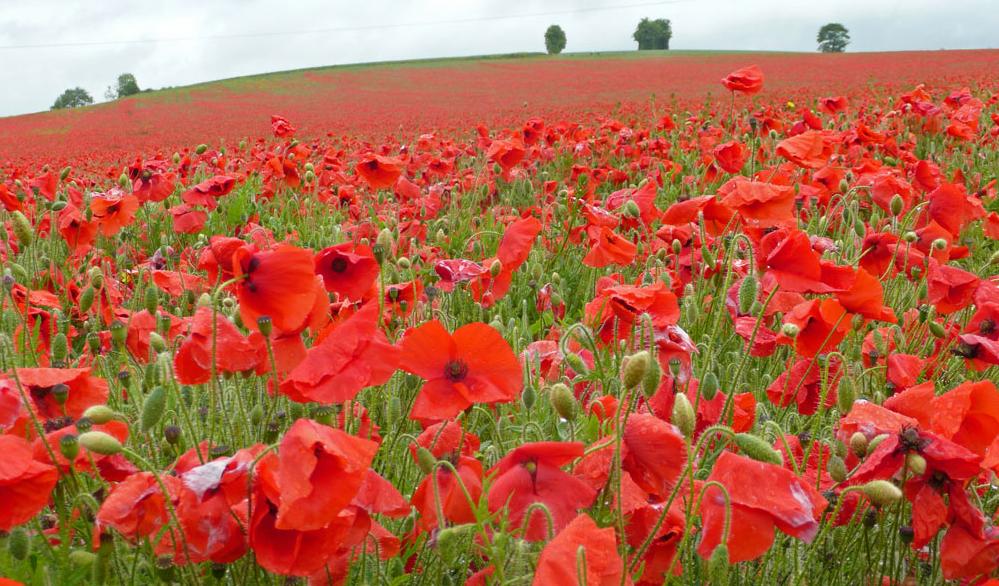
Let’s consider the poppy.

Break of Day in the Trenches, by Isaac Rosenberg (1890-1918)

The darkness crumbles away.
It is the same old druid Time as ever,
Only a live thing leaps my hand,
A queer sardonic rat,
As I pull the parapet’s poppy
To stick behind my ear.
Droll rat, they would shoot you if they knew
Your cosmopolitan sympathies.
Now you have touched this English hand
You will do the same to a German
Soon, no doubt, if it be your pleasure
To cross the sleeping green between.
It seems you inwardly grin as you pass
Strong eyes, fine limbs, haughty athletes,
Less chanced than you for life,
Bonds to the whims of murder,
Sprawled in the bowels of the earth,
The torn fields of France.
What do you see in our eyes
At the shrieking iron and flame
Hurled through still heavens?
What quaver — what heart aghast?
Poppies whose roots are in man’s veins
Drop, and are ever dropping;
But mine in my ear is safe —
Just a little white with the dust.

--

Isaac Rosenberg was raised in poverty in the East End of London. Out of work in 1915 and unable to find a job, he enlisted in the army, asking that half of his pay was sent to his mother as a “separation allowance”. Rosenberg himself was opposed to the war: in a personal letter, he wrote, "I never joined the army for patriotic reasons. Nothing can justify war. I suppose we must all fight to get the trouble over."

This poem was written sometime around 1916 whilst he was serving on the Western Front, and there are definite echoes of John McCrae’s famous poem, “In Flanders Fields”:

In Flanders fields the poppies blow
Between the crosses, row on row,
That mark our place; and in the sky
The larks, still bravely singing, fly
Scarce heard amid the guns below.

We are the Dead. Short days ago
We lived, felt dawn, saw sunset glow,
Loved and were loved, and now we lie
In Flanders fields.

Take up our quarrel with the foe:
To you from failing hands we throw
The torch; be yours to hold it high.
If ye break faith with us who die
We shall not sleep, though poppies grow
In Flanders fields.

That poem was first published – with great success – in 1915. The cult of the poppy started quickly, it seemed... this poem was widely used in fund-raising drives during the war, and it’s no coincidence that the poppy was chosen as the symbol for the first Remembrance Day in 1919. It’s entirely possible that McCrae’s poem was a direct influence ‘Break of Day in the Trenches’, although for my money, Rosenberg’s poem is both more droll and more visceral in its description of the realities for an enlisted man in the trenches on the front line. Corn poppies grew abundantly in Flanders, and were some of the first plants to spring up from battle-devastated fields. They were not mere symbols to either McCrae or to Rosenberg, who will have seen them growing in the ruins of no-man’s-land; a flash of beauty amidst the ruins and the death. The poppy's association with death goes back ages farther than the Great War. Opium poppies were found in Egyptian tombs. The Sumerians called it "the flower of joy" and the Greeks associated it with fertility…. symbolism that the poet is aware of, even if today’s poppy police decidedly are not.

In March 1918, the German Army started its Spring offensive on the Western Front. After being sent back to the front to reinforce the line against the enemy assault, Rosenberg was killed on the night of the April 1, either at the hands of a sniper or in close combat. He was buried in a mass grave.

-

A rat ran under the tyres of my bike on Monday night. Whether he was queer or sardonic, I don't know.  I think I broke his back and killed him instantly, but seeing his white belly facing the sky on the cycle path behind me made me feel quite sad.

Tuesday, 8 November 2016

the hell where youth and laughter go...


Suicide in the Trenches

I knew a simple soldier boy
Who grinned at life in empty joy,
Slept soundly through the lonesome dark,
And whistled early with the lark.

In winter trenches, cowed and glum,
With crumps and lice and lack of rum,
He put a bullet through his brain.
No one spoke of him again.

You smug-faced crowds with kindling eye
Who cheer when soldier lads march by,
Sneak home and pray you'll never know
The hell where youth and laughter go.

Siegfried Sassoon (1886-1967)

One of our greatest war poets, Sassoon was an officer who was decorated for bravery on the Western Front. His poetry both described the horrors of the trenches, and satirised the patriotic pretensions of those who he felt were responsible for a jingoism-fuelled war. Sassoon became a focal point for dissent within the armed forces when he made a lone protest against the continuation of the war in his "Soldier's Declaration" of 1917, which saw him being admitter to a military psychiatric hospital. [cribbed from his wiki entry]

Here's that declaration in full:

--

Lt. Siegfried Sassoon.
3rd Batt: Royal Welsh Fusiliers.
July, 1917.

I am making this statement as an act of wilful defiance of military authority because I believe that the war is being deliberately prolonged by those who have the power to end it. I am a soldier, convinced that I am acting on behalf of soldiers. I believe that the war upon which I entered as a war of defence and liberation has now become a war of aggression and conquest. I believe that the purposes for which I and my fellow soldiers entered upon this war should have been so clearly stated as to have made it impossible to change them and that had this been done the objects which actuated us would now be attainable by negotiation.

I have seen and endured the sufferings of the troops and I can no longer be a party to prolonging these sufferings for ends which I believe to be evil and unjust. I am not protesting against the conduct of the war, but against the political errors and insincerities for which the fighting men are being sacrificed.

On behalf of those who are suffering now, I make this protest against the deception which is being practised upon them; also I believe it may help to destroy the callous complacency with which the majority of those at home regard the continuance of agonies which they do not share and which they have not enough imagination to realise.

Sassoon himself was pretty far from being a coward - he was a war hero known to fellow soldiers as “Mad Jack” because of his persistent practice of venturing into no-man’s-land to raid the German trenches by night, crawling through the barbed wire, revolver in one hand, knobkerrie in the other, and three hand grenades in each pocket, apparently not caring whether he got back alive.

During the Battle of the Somme, he had charged a German trench single-handed, down a slope, across a railway line, and up the opposite bank: the Germans thought it was a mass attack and fled. He won the Military Cross for rescuing a wounded man under heavy German fire, and was recommended for other awards. He was in England to write that letter because a German sniper’s bullet had hit him in the shoulder, missing his jugular vein and his spine by a fraction of an inch. He was prescribed treatment at a convalescent home at Craiglockhart, near Edinburgh, and it was here that he first formed a friendship with an admiring Wilfred Owen.

Sassoon returned to the front, but in July 1918, as he was returning from another of his dangerous excursions into no-man’s-land, when he decided to savour the dawn of a beautiful summer’s day by removing his helmet and standing up to gaze at the horizon. He was shot by a British sentry who mistook him for a German; but with his usual luck, he survived, and lived to be 80.

What an incredible man and what a poet.

[text liberally pinched from here]

--

But why would we bother to listen to the testimony of those who actually fight our wars, eh? We might actually learn something. Let's just call them all heroes and keep sending them off to die anyway.

Monday, 7 November 2016

and all our plans are useless indeed...


Facebook reminded me this morning that, exactly one year ago today I was posting about the poppy and was angry about how this symbol of quiet contemplation and reflection had been hijacked and was becoming a symbol of something else entirely.  Instead of getting angry about this all over again this year, I'm just going to post some achingly sad war poetry instead.  I'm tired of being angry about this and I just want to try and spend the next few days thinking about the sacrifices people have made in war instead.

Today's poem is a monologue in which one soldier speaks to the fiancĂ© or girlfriend of a dead soldier of his death— mourning his loss and regretting that he will never have the pleasure of his friend’s company again.  The consoling beauty of the English countryside clearly isn't enough to forget the horrific memory of the bloody and maimed body of his friend.

Ivor Gurney led a somewhat tragic life: he enlisted in 1915 and was shot and later gassed (at Ypres) whilst serving on the front.  He suffered a serious mental breakdown in 1918 and spent the last 15 years of his life in psychiatric hospitals before dying of TB in 1937 at the age of only 47.  Another person whose life was irreversibly shattered by war.

--

To his love, by Ivor Gurney

He’s gone, and all our plans
Are useless indeed.
We’ll walk no more on Cotswolds
Where the sheep feed
Quietly and take no heed.

His body that was so quick
Is not as you
Knew it, on Severn River
Under the blue
Driving our small boat through.

You would not know him now…
But still he died
Nobly, so cover him over
With violets of pride
Purple from Severn side.

Cover him, cover him soon!
And with thick-set
Masses of memoried flowers-
Hide that red wet
Thing I must somehow forget.

--

Gurney is one of 16 Great War Poets commemorated on a slate stone unveiled in Westminster Abbey's Poet's Corner. The inscription on the stone was written by Wilfred Owen. It reads: "My subject is War, and the pity of War. The Poetry is in the pity."

I think that sums it up rather well.

As Harry Patch often said, "War is organised murder, and nothing else".  We should be asking more questions about the wars we fight and the impact that they have on ordinary people, soldiers and civilians alike.

Remember.

Friday, 4 November 2016

rain keeps falling down, down, down, down....

IF YE FORGET

LET me forget—Let me forget,
I am weary of remembrance,
And my brow is ever wet,
With tears of my remembrance,
With the tears and bloody sweat,—
Let me forget.

If ye forget—If ye forget,
Then your children must remember,
And their brow be ever wet,
With the tears of their remembrance,
With the tears and bloody sweat,—
If ye forget.

G.A. Studdert Kennedy

Sadly, our memories seem to be all too short.

--

Speaking of history, did I ever tell you that the title of my Masters Dissertation was "Historical Precedent and the Deposition of Henry VI".  A real page-turner of a read, it analysed how the successive depositions of Edward II (1327), Richard II (1399) and Henry VI (1461) saw the usurping kings increasingly using the authority of parliament to legitimize their rule... and each time they did, it saw the sovereign power of Parliament increase, ultimately leading to Parliament executing a king for treason in 1649.

If any journalists want to get in touch for a comment on the current high court decision on Article 50, I can be reached through my agent.

Thursday, 3 November 2016

gasping - but somehow still alive...


We're barely into November and it's started again already.. the achingly predictable series of manufactured controversies over the wearing or the not wearing of a poppy.  It's tiresome, and I'm bored both of watching the tedious value signalling and of talking about it.

The final straw for me this year - already - was watching the Prime Minister of this country, standing in the debating chamber of the Commons, in the Houses of Parliament and the heart of the political life of this nation, surrounded by elected representatives, claiming that the poppy wasn't a political symbol.

Really?  I don't think it gets much more political than that.

Instead of getting angry about it, I've decided just to skip to what I usually end up doing around Remembrance Day every year anyway: I'm going to focus on some of the tremendously moving war poetry that I like to read as I remember the sacrifices that other people have made over the years.  I find this time of year very moving, and it feels more important than ever that we keep remembering now that the living witnesses of the two World Wars are no longer with us.  Did you hear anyone during the recent referendum debates glibly taking peace in Europe for granted?  I know that I did.

Anyway.  I'm going to share some of that poetry.

Let's start with some Rudyard Kipling.

Kipling wrote this poem after his son John (called Jack), an 18-year-old Lieutenant in the 2nd Battalion, Irish Guards disappeared in September 1915 during the Battle of Loos, during World War I (this was also the first battle where British units deployed poison gas against the enemy).

'My Boy Jack'

1914-18

"HAVE you news of my boy Jack? "
Not this tide.
"When d'you think that he'll come back?"
Not with this wind blowing, and this tide.
"Has any one else had word of him?"
Not this tide.
For what is sunk will hardly swim,
Not with this wind blowing, and this tide.

"Oh, dear, what comfort can I find?"
None this tide,
Nor any tide,
Except he did not shame his kind---
Not even with that wind blowing, and that tide.

Then hold your head up all the more,
This tide,
And every tide;
Because he was the son you bore,
And gave to that wind blowing and that tide.


Wednesday, 11 November 2015

history....


MCMXIV
by Phillip Larkin

Those long uneven lines
Standing as patiently
As if they were stretched outside
The Oval or Villa Park,
The crowns of hats, the sun
On moustached archaic faces
Grinning as if it were all
An August Bank Holiday lark;

And the shut shops, the bleached
Established names on the sunblinds,
The farthings and sovereigns,
And dark-clothed children at play
Called after kings and queens,
The tin advertisements
For cocoa and twist, and the pubs
Wide open all day;

And the countryside not caring:
The place-names all hazed over
With flowering grasses, and fields
Shadowing Domesday lines
Under wheat’s restless silence;
The differently-dressed servants
With tiny rooms in huge houses,
The dust behind limousines;

Never such innocence,
Never before or since,
As changed itself to past
Without a word – the men
Leaving the gardens tidy,
The thousands of marriages,
Lasting a little while longer:
Never such innocence again.


"Progress, far from consisting in change, depends on retentiveness. When change is absolute there remains no being to improve and no direction is set for possible improvement: and when experience is not retained, as among savages, infancy is perpetual. Those who cannot remember the past are condemned to repeat it." George Santayana

Tuesday, 10 November 2015

aftermath...


Aftermath

Have you forgotten yet?...
For the world's events have rumbled on since those gagged days,
Like traffic checked while at the crossing of city-ways:
And the haunted gap in your mind has filled with thoughts that flow
Like clouds in the lit heaven of life; and you're a man reprieved to go,
Taking your peaceful share of Time, with joy to spare.
But the past is just the same--and War's a bloody game...
Have you forgotten yet?...
Look down, and swear by the slain of the War that you'll never forget.

Do you remember the dark months you held the sector at Mametz--
The nights you watched and wired and dug and piled sandbags on parapets?
Do you remember the rats; and the stench
Of corpses rotting in front of the front-line trench--
And dawn coming, dirty-white, and chill with a hopeless rain?
Do you ever stop and ask, 'Is it all going to happen again?'

Do you remember that hour of din before the attack--
And the anger, the blind compassion that seized and shook you then
As you peered at the doomed and haggard faces of your men?
Do you remember the stretcher-cases lurching back
With dying eyes and lolling heads--those ashen-grey
Masks of the lads who once were keen and kind and gay?

Have you forgotten yet?...
Look up, and swear by the green of the spring that you'll never forget.

(Siegfried Sassoon)

Monday, 9 November 2015

doomed to repeat the past....


If Ye Forget

Let me forget — Let me forget,
I am weary of remembrance,
And my brow is ever wet,
With the tears of my remembrance,
With the tears and bloody sweat,
Let me forget.

If ye forget — If ye forget,
Then your children must remember,
And their brow be ever wet,
With tears of their remembrance,
With tears and bloody sweat,
If ye forget.

G.A. Studdert Kennedy.

I'm not sure we've really remembered at all.

Not really.

link: a history of forgetting ("Red Poppies, a just, proud and precious symbol, has been devalued by Britain’s own inadequacy and is fast becoming just another simulacrum for a functioning democracy").

link: my name is Legion ("the Royal British Legion’s status as the self-appointed “national custodian of Remembrance” has been compromised through its collaboration with some of the world’s most controversial arms dealers, its increasingly militarised presentation of Remembrance, and its commercialised and trivialising corporatisation of the poppy “brand”).

("In the UK, we contribute to the work of The Royal British Legion which supports current and former members of the armed forces and their dependants, and our employees get involved in the Poppy Appeal, which raises funds for the Legion’s work and highlights the contribution of the armed forces past and present").


Sunday, 8 November 2015

remember...


SUICIDE IN THE TRENCHES

By Siegfried Sassoon

I knew a simple soldier boy
Who grinned at life in empty joy,
Slept soundly through the lonesome dark,
And whistled early with the lark.
In winter trenches, cowed and glum,
With crumps and lice and lack of rum,
He put a bullet through his brain.
No one spoke of him again.

You smug-faced crowds with kindling eye
Who cheer when soldier lads march by,
Sneak home and pray you'll never know
The hell where youth and laughter go.

say it again...


The Next War, by Osbert Sitwell

The long war had ended.
Its miseries had grown faded.
Deaf men become difficult to talk to.
Heroes become bores.

Those alchemists
Who had converted blood into gold,
Had grown elderly.
But they had a meeting,
Saying,
'We think perhaps we ought
To put up tombs
Or erect altars
To those brave lads
Who were so willingly burnt,
Or blinded,
Or maimed,
Who lost all likeness to a living thing,
Or were blown to bleeding patches of flesh
For our sakes.
It would look well.
Or we might even educate the children.'

But the richest of these wizards
Coughed gently;
And he said,
'I have always been to the front
- In private enterprise -
I yield in public spirit
To no man.
I think yours is a very good idea
- A capital idea -
And not too costly.
But it seems to me
That the cause for which we fought
Is again endangered.
What more fitting memorial for the fallen
Than that their children
Should fall for the same cause?'
Rushing eagerly into the street,
The kindly old gentleman crie
To the young:
'Will you sacrifice
Through your lethargy
What your fathers died to gain?
Our cause is in peril.
The world must be made safe for the young!'
And the children
Went...

(There's a lovely comic book adaptation of this poem here)

Remember.

Saturday, 7 November 2015

blood red....


Whilst I have the greatest of respect for those who have fought and died in the service of this country, I find the cult of the poppy disturbing and weird. Wearing or not wearing a poppy doesn't actually indicate the level of your support for veterans, does it?

If everyone in the public eye is forced to wear them or face outrage, doesn't that make the whole thing kind of meaningless?

Personally, I am incredibly moved by the quiet dignity of our veterans and I donate to the British Legion every year and choose to wear a white poppy because I think we should be asking more questions about the wars we fight in the first place.

If you could hear, at every jolt, the blood
Come gargling from the froth-corrupted lungs,
Obscene as cancer, bitter as the cud
Of vile, incurable sores on innocent tongues,
My friend, you would not tell with such high zest
To children ardent for some desperate glory,
The old Lie; Dulce et Decorum est
Pro patria mori.