Wednesday, 30 November 2016

breathe without you...

Ironically, given I have a chronic, incurable medical condition, I’m not very good at being ill. Hmm. Actually, perhaps that’s entirely unsurprising. After all, I doubt that there are many people who become fonder of hospitals the more time they spend in them.

I have a cold. I don’t think that I’m one of those guys who makes a whole song and dance about their terrible “man flu”, but I definitely don’t like being ill and I try my best to let it interfere with my life as little as possible. I think the only sick days I have ever had were 1 day when I had campylobacter and was delirious with a fever and stomach cramps, and I had to have a few days off after my lumbar puncture when the altered pressure in my central nervous system meant I couldn’t stand up for more than about half an hour without getting pounding headaches and breaking into a cold sweat. So yes, this does mean that I’m one of those people who turns up to work and coughs and splutters my way through a day. Yes, as someone with a compromised immune system myself, I could perhaps be a little more considerate… but the plain truth of the matter is that, unless I feel really unwell, I’m going to come to work. I don’t do duvet days.

With this particular cold – which developed nicely into a case of viral bronchitis – I sounded terrible, but always felt basically okay. 85% of normal, maybe – so I just tried to carry on with my life as normal. Sadly for me, this meant that I could work, but once it descended into my lungs and took up residence, exercise is out of the question. I did my last run 12 full days ago and even had to stop cycling to and from work when I started wheezing on the way home a week ago. I don’t particularly feel like exercising at the moment, but as someone who has run over 1000 miles this year and goes out 5 times a week, this is proving to be very difficult. I’ve started cursing the runners I see out on the streets under my breath. The bastards… what a bloody cheek that they’re out enjoying something I want to be doing but currently can’t. I keep setting myself little targets: I’ll start cycling to work again on Wednesday and will maybe do a little jog when I get home… but so far, my lungs just haven’t cleared up enough to make that possible (at one point this week, my wife woke me up at about 3am to rub Vicks onto my chest. It’s a lovely gesture, to be sure, but I think my coughing in my sleep was starting to fray her nerves). I think I’m going a bit crazy. I’m aiming for parkrun this week (and will be there, come hell or high water, even if I have to walk), but I’ll reluctantly have to play it by ear. Annoyingly, I’ve got a half marathon booked on Sunday next week… at this rate, even if my lungs clear up, I’m not sure it would be a very good idea. Dangnabbit. I hate being sensible.

Mind you. That being said, it’s also sort of nice to have all this time on my hands. It’s amazing how much earlier I’m getting home and how I can actually just sit down and watch telly or something like a normal person. It’s weird.

Naturally, I’ve put this time to excellent use by starting to play Skyrim again. I’m trying to make my character run everywhere.

If I can’t flog myself, I don’t really know what else to do.

Oh, and you know that thing where you cough so hard you rupture something in your ribcage and it makes coughing even more miserable?  Yeah.  That.  Good times.

Monday, 28 November 2016

FACTS


This from the New Yorker today.  As brought to my attention by my friend Marissa.

2016 is pretty much this, isn't it?

Post-truth, post-facts, sans teeth, sans eyes, sans taste, sans everything.

Friday, 25 November 2016

I shudder to breathe...


After coughing miserably for most of the last ten days, I was diagnosed yesterday with bronchitis. The doctor also helpfully told me a story about how, when he was at University, he tried to exercise with bronchitis and ended up on his hands and knees on the gym floor coughing up a ball of phlegm the size of a cricket ball.   Hmm.  Cool story, Hansel.

It’s viral, so there’s not much anyone can do about it, but at least we know, eh? (my wife tells me that I’ve even been coughing in my sleep. Sorry about that). What I also know is that my last run was a steady parkrun with C last Saturday and nothing since. I even stopped cycling to work earlier this week when my short ride home reduced me to a wheezing, spluttering wreck.

I’m sure the enforced break is a chance for my body to rest from the 1000-odd mile pounding that I’ve subjected it to so far this year… but at the same time, it’s intensely frustrating. I’m going to parkrun tomorrow to walk around at the back and to hope that a bit of fresh air will do me more good than harm. I’m also – in theory – signed up to do a Turkey Trot half marathon in a couple of weeks. If I’m remotely recovered by then, I’ll probably give it a go with no idea of a time in my head…

Running is the thing that I do that makes me feel better about myself. It can be hard and I’ve been frustrated of late that I haven’t been able to go as fast as I’d like… but I’ve been reminded this week that going slowly is a whole lot better than not going at all.

Wednesday, 23 November 2016

rolled and rumbled past my door...


Billy Bragg & Joe Henry @ Nottingham Playhouse, 
17th November 2016

So slack has my gig reviewing become that I’ve left it nearly a whole week before getting round to writing up this one. Well, better late than never. If you want to read a proper review of this gig, then you should head over to David Belbin and read the extended version of the write-up he did for the Evening Post (I have Dave to thank for the setlists too).

I’ve been a Billy Bragg fan now for 29 years. That’s a pretty long stretch by almost anyone’s standard, and can only really be matched by the likes of Iron Maiden in my record collection. The somewhat straightforward pleasures of Iron Maiden, bless them, haven’t quite provided the intellectual and emotional stimulation of the Bard of Barking over the years. Tonight, he’s performing with an old friend, Joe Henry, who, as an American abroad, immediately tells us that he feels he needs to say something about the result of the US Election: “It’s where we are. It isn’t who we are”. They’re touring “Shine a Light”, a concept album of railroad songs in the great American tradition. They recorded the songs in waiting rooms and hotel rooms as they travelled the 65 hours and 3000 miles of railroad between Chicago and Los Angeles. The railway, so they told us, is so much more evocative a form of transport than any other; it symbolises dreams and escape in a way that aeroplanes and cars (unless driven by Bruce Springsteen, Bragg quips) never quite have. Trains, of course, played a fundamental part in opening up the USA, but it seems that they are barely used as a means of passenger transportation at all these days, with some of the trains they caught in the South only leaving once per day, or even every other day. It’s all about freight nowadays, and apparently the USA ships more cargo by rail than any other nation in the world.


Of course, the songbook they’ve chosen is deep and rich and resonant. At one point, Joe tells us how these songs are the language of American culture; every bit as rich and relevant as the works of Shakespeare. He grew up with this stuff in his blood, and Bragg is no recent convert. “We’re making Americana great again” he says, to groans of “Too soon” from his American friend.

The Playhouse is a good venue to see a band. I think I’ve only seen one other band perform here (The Duckworth Lewis Method) and Billy Bragg’s more normal habitat in these parts would be Rock City… but there’s something about the packed and attentive audience seated in the auditorium that suits these songs. The two men perform together, then we get a solo set from Joe, an interval, a solo set by Bill and then some more songs from the pair of them. An obvious highlight in the first section is their cover of Leadbelly’s justly famous “In The Pines”, familiar to most people in my generation as the “Where Did You Sleep Last Night” so memorably covered by Nirvana on their Unplugged album. I’m less taken with Joe Henry’s solo stuff. It was my first listen to most of this, so perhaps it’s unfair to judge, but it felt to me as though he didn’t have a very light touch with his lyrics. He’s probably most famous for the work he did as producer to Allen Toussaint, and it’s no coincidence that I thought the best of the songs he performed in his set was his cover of Toussaint’s “Freedom for the Stallion”.

I last saw Billy Bragg at Glastonbury the day after the results of the Referendum. His set that night was electric as we like-minded souls gathered together in the hope that he would make us all feel better. It’s only been a day since Trump’s victory in the Presidential election, and I find myself again looking to Billy for some comfort. He opens with “Between the Wars”, cutting the song short before the line “Sweet moderation, heart of this nation” and seguing straight into “Help Save the Youth of America”. He also plays a cover of Anais Mitchell’s "Why We Build the Wall"... which of course has particular relevance now.

It’s a really good gig. The album is good and the two men are clearly comfortable with each other onstage and their voices dovetail together well. As ever with Billy, it’s the bits between the songs that stand out nearly as much as the songs themselves, and there’s a good story to tell about every one of these songs, both in their history and in where Bragg and Henry were when they recorded them.

It might be an increasingly crazy world, but Billy Bragg continues to provide me with the same anchor of stability that he has since I was thirteen years old and just starting to see beyond a musical world of heavy metal. Long may it continue.

Verdict: 7.5 / 10

Setlist:

Billy Bragg & Joe Henry
Railroad Bill
The L&N Don’t Stop Here Anymore
John Henry
In the Pines
Waitin’ for a Train
Early Morning Rain

Joe Henry
Trampoline
After The War
God Only Knows
Our Song
Freedom for the Stallion

Billy Bragg
Between the Wars
Help Save the Youth of America
Accident Waiting to Happen
Why We Build the Wall
There Is Power in a Union

Billy Bragg & Joe Henry
Railroading on the Great Divide
Lonesome Whistle
Rock Island Line
Hobo’s Lullaby
Midnight Special

Encore:
Gentle on My Mind
Tonight I’ll Be Staying Here With You
Ramblin’ Round

Tuesday, 22 November 2016

wet...


We need to talk about my bladder.

Well.  To be honest, I think there's a pretty good chance that you could probably do without this particular chat...but I'm going to talk about it anyway.  If you're squeamish, it's probably best to look away now.

In some ways, I'm an atypical MS patient: as I'm very aware, there's not all that many of us who are able to run marathons. That's not to say that I don't have any problems at all.  I know that I've talked a lot here about the loss of muscle strength in my left hand side and the challenges that gives me with my running, but I haven't really talked at length about anything else.  I might have mentioned my bladder before, but not surprisingly, it's not something that I particularly care to dwell on.

I've never had a particularly strong bladder.  I've always been one of those people who goes when I can and not when I have to, and I have a certain reputation amongst my friends as having a smaller than average bladder capacity.  Over the last few years, and like many people who suffer from multiple sclerosis, I've noticed some changes... sometimes, my bladder doesn't seem to empty properly when I visit the toilet, and I find myself needing to go back for another visit almost immediately; I experience something of a 'rush bladder' too: this is where you get a sudden, pressing urge to pee and have to stop whatever you're doing and try to get to a toilet as quickly as you can before you have an accident.  Sometimes, at times like these, there can be a little leakage too; I sometimes also need to get up several times during the night. It's not terribly by any means, but it can be a bit awkward and sometimes a little bit embarrassing.

I did see a nurse about this for a bit, but other than trying to discipline myself to only go to the toilet when I really, really needed to go, there didn't seem much point in doing anything else.  I definitely don't want to go onto medication, and to be frank, nothing I was experiencing was really serious enough to pursue any further.

All these things are very common in people with multiple sclerosis.  If you look at the spectrum of possible symptoms (and, frankly, I try not to), then you'll see that bladder problems are very common -- according to the MS Trust, they will affect up to 75 MS patients out of 100. Self-catheterisation might not be something you care to think about, but for lots of people, this is a practical way of managing an issue that might otherwise dominate your life.

I mention all this because this has started happening to me.  Beyond the frequent need to get up in the night and pee, I actually woke up in the small hours of Sunday morning, made a trip to the bathroom and came back to find that I'd actually already wet the bed.  At first I didn't believe that this could have happened - why on earth did I go to the bathroom and pee if I'd already emptied my bladder? Surely that must be something else, right?  Sweat, maybe? Then I was just shocked and embarrassed. What else could it be? My wife was absolutely brilliant and rushed to reassure me and to get things straightened out... but I have to tell you, dear reader, I was appalled and distressed.  We'd been out at a friend's house for a party, but I'd had a couple of beers and a couple of glasses of wine all night... nothing out of the ordinary for a weekend and nothing much for several hours.  Why was this happening to me now?  Why did it happen at all?  I have a bit of a cold and a nasty cough at the moment and spent about 18 hours of the following day asleep in bed: perhaps that was a trigger?  I honestly don't know.

I'm a rational man, and my brain is telling me that, although this might not be a one-off, I really shouldn't start worrying about this until it become a more regular occurrence in my life.  And if it does start happening more often, then I have the support network in place and access to great medical care so that I can do something about it...... but I have to tell you that I'm now living slightly on edge in case it does happen again.  What about when I'm staying round at someone else's house? I've made some practical purchases, but really... I'm 42 years old and this really wasn't where I hoped I'd be at this stage in my life.  Should I stop drinking caffeine and alcohol or what? Are espresso martinis now a thing of the past for me?

Why am I telling you this?  Well, because I think it's important that we talk about these things. If I'm happy enough to trumpet to you about my wonderful achievements running with MS, then I think it's probably only fair that I'm also realistic about the other ways that my multiple sclerosis is affecting me.  It might feel a bit embarrassing, but there's really nothing to be ashamed of here.

Life can certainly throw a lot of shit in your direction, but it only beats you if you let it.

We will endure.

Monday, 21 November 2016

nothing else matters...


Metallica have just released their first studio album since 2008.  It's receiving some decent reviews, but Metallica being Metallica, there are also plenty of haters lining up to complain that this album isn't anywhere near as good as [insert name of Metallica album here, probably from the mid-1980s, but if feeling awkward then Load].

I'm quite keen to give it a listen.

Sadly I can't.  Not for another couple of weeks, anyway.  And it's all my own bloody fault too... totally self-inflicted*.

It's nearly the end of the season at choir.  In just over a week, and with two more practice sessions to go, we'll be into the Christmas concerts.  I want to perform these 'books down' so that I can concentrate on the cues from our musical director, but this means that I need to actually learn the damn songs.  Unfortunately, this means that I have spent an inordinate amount of time over the last few weeks listening to nothing but my choir rehearsal tracks - rather dull MP3s that very plainly highlight the voice part that you're trying to learn.... bass, in my case... and pretty much nothing else. They certainly don't highlight the songs to their best effect, anyway.


This works up to a point, helping you to learn your voice part (they're especially useful if you think you already know the song, when actually you know the melody but not the harmony you'll be singing).  But there are always a few songs that refuse to completely go in... the final 15% just seems to get stuck and you need to put in that bit of extra effort to get them properly learnt.

Sadly, for me, from this season's songs, the ones that require the work are:

- Merry Christmas Everyone (bloody Shakin Stevens!)
- Jingle Bell Rock (fiddly opening lyrics)
- That's Christmas to Me

...so I'm spending all my spare time at the moment listening to a crappy backing track version of a Shakin Stevens song that I hated before we even started the season.

Brilliant.  It's about the least metal reason there could possibly be for not listening to the new Metallica album.  I defy you to think of a less metal reason than that.

Pah.

* I'm a slave to my art.

Thursday, 17 November 2016

almost so clear...


Dear Mr. Swisslet

This is to update you regarding the MRI you had recently [recently? the beginning of September...but do go on].  It did show low volume of white matter lesions which is consistent with a very mild form of multiple sclerosis you have.  The MRI of the brain and of the spinal cord has been reassuring.

We will meet in the clinic as planned [at the end of next year] but do let me know if you have any new issues.


Yours sincerely

Dicated and signed to avoid delay

[to avoid delay? are you kidding me?]

---

That's pretty good news in neurology speak, I think.  Don't you?  (I think it also suggests that they never did find those comparison scans from 2005, but that's okay).

I clearly have no excuses for not running faster that I am currently, eh?

Tuesday, 15 November 2016

sorrow's native son...

There’s an article about the “alt-right” on the Guardian today and it introduced me to the strange and alarming concept of “the Manosphere”.

"For several years now, I’ve had a dark and fairly unusual hobby. When I’m alone and bored and the mood strikes me, I’ll open up my laptop and head for a particularly unsavoury corner of the internet. No, not the bit you’re thinking of. Somewhere far worse. That loose network of blogs, forums, subreddits and alternative media publications colloquially known as the “manosphere”. An online subculture centred around hatred, anger and resentment of feminism specifically, and women more broadly. It’s grimly fascinating and now troubling relevant. In modern parlance, this is part of the phenomenon known as the “alt-right”. More sympathetic commentators portray it as “a backlash to PC culture” and critics call it out as neofascism….On their forums I’ve read long, furious manifestos claiming that women are all sluts who “ride the cock carousel” and sleep with a series of “alpha males” until they reach the end of their sexual prime, at which point they seek out a “beta cuck” to settle down with for financial security. I’ve lurked silently on blogs dedicated to “pick-up artistry” as men argue that uppity, opinionated, feminist women – women like myself – need to be put in their place through “corrective rape”."

This is all darkly fascinating and troubling, of course, and given a sharp relevance by the appointment of Breitbart’s Steve Bannon to a senior role in Trump’s White House staff. What captures my attention is how this chimes with my own experience:

From the age of seven until the age of eighteen, I attended boarding schools that were, to all intents and purposes, single sex. Sure, there were girls, but they were in an overwhelming minority and were generally treated, at best, as being a completely different species. I don’t have any sisters and, separated from my mother for long periods of time, this meant that I spent the majority of my formative years surrounded only by other boys and with very little feminine influence. I’m pretty confident that this left me emotionally scarred to the extent that I found it difficult to form meaningful relationships with girls. I don’t want to exaggerate the impact this had on me: I’m still friends with one girl I met at school when we were both 17, and I like to think I was perfectly capable of interacting relatively normally with women… it’s just that it took me a long time (and, trust me, it felt like an absolute bloody age) to be able to get myself a proper girlfriend. Even that makes it sound like I knew what I was doing; truth be told, I met the girl who was prepared to look past my rough edges and decide that I was worth persevering with. I don’t think I really had all that much to do with it.

Would this have made me a candidate for the Manosphere? Perhaps, although I’d like to think that I focused all my anger and frustration inwardly. I never blamed anybody but myself for my inadequacies and I certainly never blamed the girls. Actually, the prevailing attitude at my school towards girls was pretty shocking. There was one guy in my year who seemed to delight in using his “power” (he was popular, confident and privileged) to seduce girls. He’d work on them for a few weeks, to the point where they thought he was “the one”, and then, once he’d got access to whatever he needed, he dropped them and never spoke to them again. He was 18 and these girls were 17. He thought this was funny, and so did many others. Lots of the boys, I’m sure, thought this was behaviour to be admired because he was getting some from these stupid girls. To be honest, I was just appalled that you could treat another human being so callously. Did I wish that I was more successful with girls? Of course, but I was damned if this was going to be the way that I went about it…. even if I had that sort of confidence, which I definitely did not.

Then, like so many people before me, I discovered the music The Smiths. It’s cliché, of course, but in my late teenage years, Morrissey seemed to be speaking directly to me and articulating the things that I felt.

And in the darkened underpass
I thought oh God, my chance has come at last
(But then a strange fear gripped me and I
Just couldn't ask)

And then I grew up. I don’t know exactly when this happened, but it wasn’t until some point in my early-20s (well, they do say that men mature more slowly than women). I’m probably definitely still emotionally crippled in lots of ways, but I finally met someone and fell in love and put a lot some of my confusion and frustrations behind me. Perhaps I’ve been lucky (I frequently tell people that I still don’t really understand why my wife ever looked at me twice, or indeed why she still seems to like me), but my life has been filled by intelligent, powerful women. In fact, depending on how you gauge these things, I would say that the women in my life have generally been more successful than the men. Some would probably think that says a lot about the weak “beta cucks” that I hang around with, but I think perhaps it just goes to show that girls are brilliant. Why be threatened by these wonderful creatures?

Why would you want to be that guy?  As Noel Gallagher once memorably said about his younger brother, don't be a man with a fork in a world of soup.

Friday, 11 November 2016

swear by the green of the spring that you'll never forget...


Aftermath by Siegfried Sassoon.

Have you forgotten yet?...
For the world's events have rumbled on since those gagged days,
Like traffic checked while at the crossing of city-ways:
And the haunted gap in your mind has filled with thoughts that flow
Like clouds in the lit heaven of life; and you're a man reprieved to go,
Taking your peaceful share of Time, with joy to spare.
But the past is just the same--and War's a bloody game...
Have you forgotten yet?...
Look down, and swear by the slain of the War that you'll never forget.

Do you remember the dark months you held the sector at Mametz--
The nights you watched and wired and dug and piled sandbags on parapets?
Do you remember the rats; and the stench
Of corpses rotting in front of the front-line trench--
And dawn coming, dirty-white, and chill with a hopeless rain?
Do you ever stop and ask, 'Is it all going to happen again?'

Do you remember that hour of din before the attack--
And the anger, the blind compassion that seized and shook you then
As you peered at the doomed and haggard faces of your men?
Do you remember the stretcher-cases lurching back
With dying eyes and lolling heads--those ashen-grey
Masks of the lads who once were keen and kind and gay?

Have you forgotten yet?...
Look up, and swear by the green of the spring that you'll never forget.

---

Somehow, this poem is made all the more poignant by the knowledge that Sassoon survived the war and lived to be 80.

In 1939, he got to see it all happen again and to see exactly how much we had forgotten.

We keep forgetting.  We say we don't, but we do.

---

I've tried hard to rise above it this year, but to illustrate again how often I get exercised by the idiots that surface at around this time of year, and in honour of this evening's England v Scotland match, here's a post on the subject of poppies and football.  I wrote it initially in 2009, posted it again in 2011 and could pretty much just as easily put the whole thing up again this year.

How about we just try and pay quiet tribute to the fallen without trying to score points about how much more we care than anyone else?

Thursday, 10 November 2016

ardent for some desperate glory...


I’m conscious that I tend to only post war poetry of the “boom, boom, boom” variety. I suppose the more optimistic stuff doesn’t really fit with the view of the First World War that I’m looking to portray. When we think about “the war to end all wars”, we tend to think of the horror of the trenches and the senseless deaths of all those men walking through No Man’s Land into the machinegun fire.

“Dulce and Decorum Est” seems to be a million miles away from the romantic optimism of Rupert Brooke’s “The Soldier”. The one was written in 1914 and romanticises a soldier dying for his country; the other was written in 1917 and captures the brutal reality of trench warfare.

The Soldier, by Rupert Brooke

If I should die, think only this of me:
That there’s some corner of a foreign field
That is forever England. There shall be
In that rich earth a richer dust concealed;
A dust whom England bore, shaped, made aware,
Gave, once, her flowers to love, her ways to roam,
A body of England’s, breathing English air,
Washed by the rivers, blest by the suns of home.
And think, this heart, all evil shed away,
A pulse in the eternal mind, no less
Gives somewhere back the thoughts by England given;
Her sights and sounds; dreams happy as her day;
And laughter, learnt of friends; and gentleness,
In hearts at peace, under an English heaven.

This sentiment seems somewhat at odds with Owen’s most famous poem.

Dulce et Decorum Est, by Wilfred Owen

Bent double, like old beggars under sacks,
Knock-kneed, coughing like hags, we cursed through sludge,
Till on the haunting flares we turned our backs
And towards our distant rest began to trudge.
Men marched asleep. Many had lost their boots
But limped on, blood-shod. All went lame; all blind;
Drunk with fatigue; deaf even to the hoots
Of tired, outstripped Five-Nines that dropped behind.

Gas! GAS! Quick, boys! - An ecstasy of fumbling,
Fitting the clumsy helmets just in time;
But someone still was yelling out and stumbling
And flound'ring like a man in fire or lime ...
Dim, through the misty panes and thick green light,
As under a green sea, I saw him drowning.

In all my dreams, before my helpless sight,
He plunges at me, guttering, choking, drowning.

If in some smothering dreams you too could pace
Behind the wagon that we flung him in,
And watch the white eyes writhing in his face,
His hanging face, like a devil's sick of sin;
If you could hear, at every jolt, the blood
Come gargling from the froth-corrupted lungs,
Obscene as cancer, bitter as the cud
Of vile, incurable sores on innocent tongues, --
My friend, you would not tell with such high zest
To children ardent for some desperate glory,
The old lie: Dulce et decorum est Pro patria mori.

The optimism of 1914, it seems, is long dead by 1917/18.  Brooke himself died in 1915 whilst en-route to Gallipoli… perhaps not quite the heroic and glamorous death he imagined for himself: sepsis from an infected mosquito bite...but, in spite of this, he was almost immediately eulogised in England as the first poetic martyr of the war.  Winston Churchill himself even described Brooke as "all that one could wish England's noblest sons to be".

Our own views of the “Great War” are now indelibly bound up with the work of the trench poets like Owen and Siegfried Sassoon – it’s impossible to imagine that a programme like Blackadder Goes Forth - with that famous, poignant last scene of poppy fetishism - could have been made without them. Actually, optimistic poetry about the First World War was written throughout the course of the war. The trench poets tend to be the ones that we remember now, but they were very much in the minority at the time. We might find it hard to imagine when we look at what they were fighting for, but those involved didn’t like to think that they were dying for nothing and preferred to see themselves caught up in a more noble struggle; their betters knew what they were doing and wouldn’t be asking them to die for no reason, right?

Charles Carrington, a survivor of both the Somme and Passchendaele was moved to write, "Just smile and make an old soldier's wry joke when you see yourself on the television screen, agonised and woebegone, trudging from disaster to disaster, knee-deep in moral as well as physical mud, hesitant about your purpose, submissive to harsh, irrelevant discipline, mistrustful of your commanders.  Is it any use to assert that I was not like that, and my dead friends were not like that, and the old cronies I meet at reunions are not like that?"

It's funny how history can be warped over time, isn't it? What you think you know isn't ever really the way it was.

Anyway.

I look around at our “Help for Heroes” culture, where every soldier who has served is a hero serving their country in a just cause, and I do wonder if history has taught us anything.

You don't have to look far to see that the old lie is still very much alive and well today. Dulce et decorum est Pro patria mori.

Wednesday, 9 November 2016

bonds to the whims of murder...


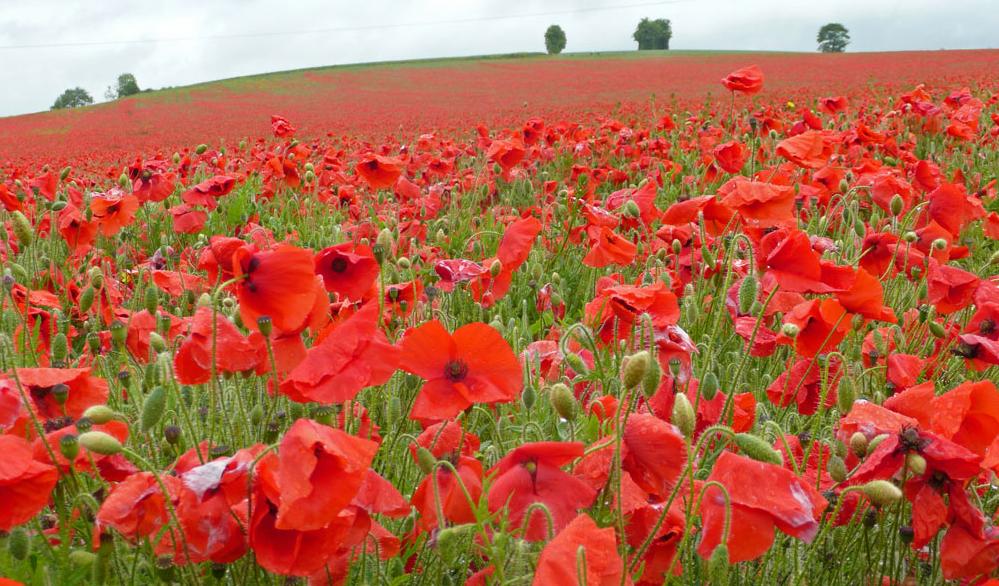
Let’s consider the poppy.

Break of Day in the Trenches, by Isaac Rosenberg (1890-1918)

The darkness crumbles away.
It is the same old druid Time as ever,
Only a live thing leaps my hand,
A queer sardonic rat,
As I pull the parapet’s poppy
To stick behind my ear.
Droll rat, they would shoot you if they knew
Your cosmopolitan sympathies.
Now you have touched this English hand
You will do the same to a German
Soon, no doubt, if it be your pleasure
To cross the sleeping green between.
It seems you inwardly grin as you pass
Strong eyes, fine limbs, haughty athletes,
Less chanced than you for life,
Bonds to the whims of murder,
Sprawled in the bowels of the earth,
The torn fields of France.
What do you see in our eyes
At the shrieking iron and flame
Hurled through still heavens?
What quaver — what heart aghast?
Poppies whose roots are in man’s veins
Drop, and are ever dropping;
But mine in my ear is safe —
Just a little white with the dust.

--

Isaac Rosenberg was raised in poverty in the East End of London. Out of work in 1915 and unable to find a job, he enlisted in the army, asking that half of his pay was sent to his mother as a “separation allowance”. Rosenberg himself was opposed to the war: in a personal letter, he wrote, "I never joined the army for patriotic reasons. Nothing can justify war. I suppose we must all fight to get the trouble over."

This poem was written sometime around 1916 whilst he was serving on the Western Front, and there are definite echoes of John McCrae’s famous poem, “In Flanders Fields”:

In Flanders fields the poppies blow
Between the crosses, row on row,
That mark our place; and in the sky
The larks, still bravely singing, fly
Scarce heard amid the guns below.

We are the Dead. Short days ago
We lived, felt dawn, saw sunset glow,
Loved and were loved, and now we lie
In Flanders fields.

Take up our quarrel with the foe:
To you from failing hands we throw
The torch; be yours to hold it high.
If ye break faith with us who die
We shall not sleep, though poppies grow
In Flanders fields.

That poem was first published – with great success – in 1915. The cult of the poppy started quickly, it seemed... this poem was widely used in fund-raising drives during the war, and it’s no coincidence that the poppy was chosen as the symbol for the first Remembrance Day in 1919. It’s entirely possible that McCrae’s poem was a direct influence ‘Break of Day in the Trenches’, although for my money, Rosenberg’s poem is both more droll and more visceral in its description of the realities for an enlisted man in the trenches on the front line. Corn poppies grew abundantly in Flanders, and were some of the first plants to spring up from battle-devastated fields. They were not mere symbols to either McCrae or to Rosenberg, who will have seen them growing in the ruins of no-man’s-land; a flash of beauty amidst the ruins and the death. The poppy's association with death goes back ages farther than the Great War. Opium poppies were found in Egyptian tombs. The Sumerians called it "the flower of joy" and the Greeks associated it with fertility…. symbolism that the poet is aware of, even if today’s poppy police decidedly are not.

In March 1918, the German Army started its Spring offensive on the Western Front. After being sent back to the front to reinforce the line against the enemy assault, Rosenberg was killed on the night of the April 1, either at the hands of a sniper or in close combat. He was buried in a mass grave.

-

A rat ran under the tyres of my bike on Monday night. Whether he was queer or sardonic, I don't know.  I think I broke his back and killed him instantly, but seeing his white belly facing the sky on the cycle path behind me made me feel quite sad.

Tuesday, 8 November 2016

the hell where youth and laughter go...


Suicide in the Trenches

I knew a simple soldier boy
Who grinned at life in empty joy,
Slept soundly through the lonesome dark,
And whistled early with the lark.

In winter trenches, cowed and glum,
With crumps and lice and lack of rum,
He put a bullet through his brain.
No one spoke of him again.

You smug-faced crowds with kindling eye
Who cheer when soldier lads march by,
Sneak home and pray you'll never know
The hell where youth and laughter go.

Siegfried Sassoon (1886-1967)

One of our greatest war poets, Sassoon was an officer who was decorated for bravery on the Western Front. His poetry both described the horrors of the trenches, and satirised the patriotic pretensions of those who he felt were responsible for a jingoism-fuelled war. Sassoon became a focal point for dissent within the armed forces when he made a lone protest against the continuation of the war in his "Soldier's Declaration" of 1917, which saw him being admitter to a military psychiatric hospital. [cribbed from his wiki entry]

Here's that declaration in full:

--

Lt. Siegfried Sassoon.
3rd Batt: Royal Welsh Fusiliers.
July, 1917.

I am making this statement as an act of wilful defiance of military authority because I believe that the war is being deliberately prolonged by those who have the power to end it. I am a soldier, convinced that I am acting on behalf of soldiers. I believe that the war upon which I entered as a war of defence and liberation has now become a war of aggression and conquest. I believe that the purposes for which I and my fellow soldiers entered upon this war should have been so clearly stated as to have made it impossible to change them and that had this been done the objects which actuated us would now be attainable by negotiation.

I have seen and endured the sufferings of the troops and I can no longer be a party to prolonging these sufferings for ends which I believe to be evil and unjust. I am not protesting against the conduct of the war, but against the political errors and insincerities for which the fighting men are being sacrificed.

On behalf of those who are suffering now, I make this protest against the deception which is being practised upon them; also I believe it may help to destroy the callous complacency with which the majority of those at home regard the continuance of agonies which they do not share and which they have not enough imagination to realise.

Sassoon himself was pretty far from being a coward - he was a war hero known to fellow soldiers as “Mad Jack” because of his persistent practice of venturing into no-man’s-land to raid the German trenches by night, crawling through the barbed wire, revolver in one hand, knobkerrie in the other, and three hand grenades in each pocket, apparently not caring whether he got back alive.

During the Battle of the Somme, he had charged a German trench single-handed, down a slope, across a railway line, and up the opposite bank: the Germans thought it was a mass attack and fled. He won the Military Cross for rescuing a wounded man under heavy German fire, and was recommended for other awards. He was in England to write that letter because a German sniper’s bullet had hit him in the shoulder, missing his jugular vein and his spine by a fraction of an inch. He was prescribed treatment at a convalescent home at Craiglockhart, near Edinburgh, and it was here that he first formed a friendship with an admiring Wilfred Owen.

Sassoon returned to the front, but in July 1918, as he was returning from another of his dangerous excursions into no-man’s-land, when he decided to savour the dawn of a beautiful summer’s day by removing his helmet and standing up to gaze at the horizon. He was shot by a British sentry who mistook him for a German; but with his usual luck, he survived, and lived to be 80.

What an incredible man and what a poet.

[text liberally pinched from here]

--

But why would we bother to listen to the testimony of those who actually fight our wars, eh? We might actually learn something. Let's just call them all heroes and keep sending them off to die anyway.

Monday, 7 November 2016

and all our plans are useless indeed...


Facebook reminded me this morning that, exactly one year ago today I was posting about the poppy and was angry about how this symbol of quiet contemplation and reflection had been hijacked and was becoming a symbol of something else entirely.  Instead of getting angry about this all over again this year, I'm just going to post some achingly sad war poetry instead.  I'm tired of being angry about this and I just want to try and spend the next few days thinking about the sacrifices people have made in war instead.

Today's poem is a monologue in which one soldier speaks to the fiancé or girlfriend of a dead soldier of his death— mourning his loss and regretting that he will never have the pleasure of his friend’s company again.  The consoling beauty of the English countryside clearly isn't enough to forget the horrific memory of the bloody and maimed body of his friend.

Ivor Gurney led a somewhat tragic life: he enlisted in 1915 and was shot and later gassed (at Ypres) whilst serving on the front.  He suffered a serious mental breakdown in 1918 and spent the last 15 years of his life in psychiatric hospitals before dying of TB in 1937 at the age of only 47.  Another person whose life was irreversibly shattered by war.

--

To his love, by Ivor Gurney

He’s gone, and all our plans
Are useless indeed.
We’ll walk no more on Cotswolds
Where the sheep feed
Quietly and take no heed.

His body that was so quick
Is not as you
Knew it, on Severn River
Under the blue
Driving our small boat through.

You would not know him now…
But still he died
Nobly, so cover him over
With violets of pride
Purple from Severn side.

Cover him, cover him soon!
And with thick-set
Masses of memoried flowers-
Hide that red wet
Thing I must somehow forget.

--

Gurney is one of 16 Great War Poets commemorated on a slate stone unveiled in Westminster Abbey's Poet's Corner. The inscription on the stone was written by Wilfred Owen. It reads: "My subject is War, and the pity of War. The Poetry is in the pity."

I think that sums it up rather well.

As Harry Patch often said, "War is organised murder, and nothing else".  We should be asking more questions about the wars we fight and the impact that they have on ordinary people, soldiers and civilians alike.

Remember.

Friday, 4 November 2016

rain keeps falling down, down, down, down....

IF YE FORGET

LET me forget—Let me forget,
I am weary of remembrance,
And my brow is ever wet,
With tears of my remembrance,
With the tears and bloody sweat,—
Let me forget.

If ye forget—If ye forget,
Then your children must remember,
And their brow be ever wet,
With the tears of their remembrance,
With the tears and bloody sweat,—
If ye forget.

G.A. Studdert Kennedy

Sadly, our memories seem to be all too short.

--

Speaking of history, did I ever tell you that the title of my Masters Dissertation was "Historical Precedent and the Deposition of Henry VI".  A real page-turner of a read, it analysed how the successive depositions of Edward II (1327), Richard II (1399) and Henry VI (1461) saw the usurping kings increasingly using the authority of parliament to legitimize their rule... and each time they did, it saw the sovereign power of Parliament increase, ultimately leading to Parliament executing a king for treason in 1649.

If any journalists want to get in touch for a comment on the current high court decision on Article 50, I can be reached through my agent.

Thursday, 3 November 2016

gasping - but somehow still alive...


We're barely into November and it's started again already.. the achingly predictable series of manufactured controversies over the wearing or the not wearing of a poppy.  It's tiresome, and I'm bored both of watching the tedious value signalling and of talking about it.

The final straw for me this year - already - was watching the Prime Minister of this country, standing in the debating chamber of the Commons, in the Houses of Parliament and the heart of the political life of this nation, surrounded by elected representatives, claiming that the poppy wasn't a political symbol.

Really?  I don't think it gets much more political than that.

Instead of getting angry about it, I've decided just to skip to what I usually end up doing around Remembrance Day every year anyway: I'm going to focus on some of the tremendously moving war poetry that I like to read as I remember the sacrifices that other people have made over the years.  I find this time of year very moving, and it feels more important than ever that we keep remembering now that the living witnesses of the two World Wars are no longer with us.  Did you hear anyone during the recent referendum debates glibly taking peace in Europe for granted?  I know that I did.

Anyway.  I'm going to share some of that poetry.

Let's start with some Rudyard Kipling.

Kipling wrote this poem after his son John (called Jack), an 18-year-old Lieutenant in the 2nd Battalion, Irish Guards disappeared in September 1915 during the Battle of Loos, during World War I (this was also the first battle where British units deployed poison gas against the enemy).

'My Boy Jack'

1914-18

"HAVE you news of my boy Jack? "
Not this tide.
"When d'you think that he'll come back?"
Not with this wind blowing, and this tide.
"Has any one else had word of him?"
Not this tide.
For what is sunk will hardly swim,
Not with this wind blowing, and this tide.

"Oh, dear, what comfort can I find?"
None this tide,
Nor any tide,
Except he did not shame his kind---
Not even with that wind blowing, and that tide.

Then hold your head up all the more,
This tide,
And every tide;
Because he was the son you bore,
And gave to that wind blowing and that tide.


Wednesday, 2 November 2016

centerfold...


I've had some post from the MS Trust.

It's a little pamphlet suggesting ways that you can raise money to support what is a very worth charity indeed.  My wife is a trustee now, you know. There's a Survival skills weekend, a Grand Canyon Trek, an Alps Trek, an Iceland Trek, a Sahara Trek, a Great Wall of China Trek, a Kilimanjaro Trek... lots of Treks.

Don't fancy that? How about cycling? You can cycle London to Paris, the Prudential Ride London-Surrey 100, London to Brighton, the MS Circuit Challenge at Goodwood.

No? How about skydiving, a reindeer rally, attending a massive garden party, baking a cake for a Christmas Cake Off or maybe just painting yourself blue?  It's all here.

What about running?  Well,  let's see: you can do the British 10k London Run, the Great North Run.....

....oh, wait a minute.... what's this?


Oh man.  That guy gets everywhere.

But you know, there's a reminder in the back of the booklet about why we do these things:

"Because we receive no government funding, we rely on our supporters to fund our vital work.  People like you, who donate or take part in events like the ones in this brochure, contribute one third of our total income.  All the pennies, all the pounds you collect by running, cycling, partying or baking, really add up.

"The funds you raise will make a difference today for people living with MS.  You could help fund a new MS nurse for people who are currently having to manage MS alone.

"You could help train and support every MS specialist nurse in the UK to make a difference for hundreds of thousands of people with MS.

"And you could help to make sure that there's reliable, trustworthy information available to help everyone with MS make decisions that are right for them."


And as Lucy says here, you have a chance to prove that love for life can prevail over illness.

More power to them, I say.  All of the runners, cyclists, trekkers, bakers, jumpers.... the whole damn lot of them.

Tuesday, 1 November 2016

spasticus...


Do you remember the special adverts that were commissioned as part of Channel 4's coverage of the Rio Paralympics? There was an all-signed ad-break during The Last Leg, but there was also a notable series of Maltesers adverts.  Here's a bit from the press release:

"Mars Chocolate UK will launch a new series of adverts for the MALTESERS® brand that champion diversity and disability. They will be broadcast for the first time on Channel 4 during the 2016 Paralympics Games Opening Ceremony tomorrow evening (7th September).

The new ads, created by Mars Chocolate and AMV, are the latest in the MALTESERS® ‘Look on the Light Side’ series and were developed in response to Channel 4’s Superhumans Wanted competition. Mars Chocolate UK and creative agency AMV won £1million of the broadcaster’s commercial airtime for developing a bold, creative idea which puts disability and diversity at the heart of their campaign.

The series comprises three ad creatives, all inspired by real-life stories from disabled people, celebrating universally awkward situations; from embarrassing moments with new boyfriends to behaving badly at a wedding – where the best thing to do is simply look on the light side of life."

New Boyfriend

Dance Floor

Theo's Dog

I loved them.  "New Boyfriend" in particular had me double-taking and then laughing out loud because it was so funny and... well, because it was so filthy. Watch it for yourself.  I thought they were great because they seemed to be doing something that we don't see on television all that often: people with disabilities being shown as normal people who talk about normal things and, instead of having people treating them like they're made of porcelain, we seem them making jokes about themselves and their situation.  American Dad has been doing this for decades, of course, but it seems somehow revolutionary to see it on an ad break on Channel 4... even when these adverts are sandwiching the incredible sporting achievements of the superhumans.

Anyway, a couple of months later, the Guardian has put up a comment piece on these adverts. They're not a fan, at least not unreservedly:

"First, without restraint, a big cheer for the actors. Disabled actors – they exist after all. And are doing a great job here. Three all at once in an ad campaign, coming along just like buses. Out in the shiny mainstream world, Metro positively drools and declares the ad has been “widely lauded”, and quotes a viewer from Twitter: “Best Maltesers advert ever!!”. On the Maltesers YouTube page, the comments range from hilarious, to worried, to downright weird – perhaps presenting a grim equality of sorts.

"It’s bound to get messy. It’s about selling a chocolate product after all – and is it really worth some of us feeling unhappy? It does grate on me given that the advertising industry is part of the capitalist agenda. And sadly, featuring a few disabled actors in an advert isn’t really likely to be a major skirmish in its downfall. Nor is it likely to explode barriers and negative attitudes. Or is it?

"Lisa Hammond, who plays Donna Yates in EastEnders, said: “All of the actors in the ads are great … that they are all women makes me happy. The issue is the fact that every one of the adverts’ focus is impairment, as part of the story. We’ve been banging on about this for years – feels like we are in a perpetual loop! And I’m interested in the deeper story.”

"I know what she means. I’m always interested in a deeper story. But this has parallels with the way that race is always the issue in the representation of BAME people on screen. But I don’t want to be forever a bloody issue – only an issue – even if it’s just an advert."

Hmm.

I'm not disabled - or, at least, I don't consider myself to be disabled - so perhaps I'm not attuned enough to see the problem with these adverts.  I find it very easy to believe that, if this is your life, then your radar is probably a lot more sensitive to these sorts of nuances (...goodness knows I'm sensitive enough to *any* passing mention of MS in the media or on the telly).  To be honest though, these are adverts, and what advert ever made managed - or even tried - to create a rounded picture of someone and their life? I'm inclined to think that the very fact we're having this sort of conversation about these adverts shows how far we've come... we're talking about the sex life of someone in a wheelchair, for goodness sake! (hats off to the advertising agency for getting such an obvious reference to ejaculation into an advert, by the way.  I can't think that I've ever seen something like that in an advert before, able-bodied or otherwise).

We've doubtless got a long way still to go, but we certainly don't lock disabled people away any more because they're not fit to be seen in decent company. Not in this country anyway.  Not at the moment, anyway.  Who knows what will happen after brexit.

As the great Ian Dury sang:

Hello to you out there in Normal Land
You may not comprehend my tale or understand
As I crawl past your window give me lucky looks
You can be my body but you'll never read my books

They played Spasticus Autisticus at the closing ceremony of the 2012 Paralympics, actually.  It still makes people gloriously uncomfortable, and there's power in that.